

Introduction
The future of digital marketing is being shaped by artificial intelligence, changing search behavior, personalization, automation, video, social commerce and data-driven decision-making. Digital marketing has moved far beyond traditional SEO, social media posts and online advertisements.
Earlier research from Gutenberg, D.Y. Patil Online and Geeta University identified AI, personalization, video marketing, voice search, social commerce, privacy, influencer marketing, AR/VR and first-party data as important developments.
In 2026, these trends are developing further. AI is becoming integrated directly into search engines, advertising platforms and marketing workflows. Google says AI Mode has surpassed one billion monthly users, while its newer Search experience supports conversational and multimodal queries using text, images, files and videos.
For businesses and marketers, this means the next generation of digital marketing will require a combination of technology, creativity, data, customer understanding and strategic thinking.
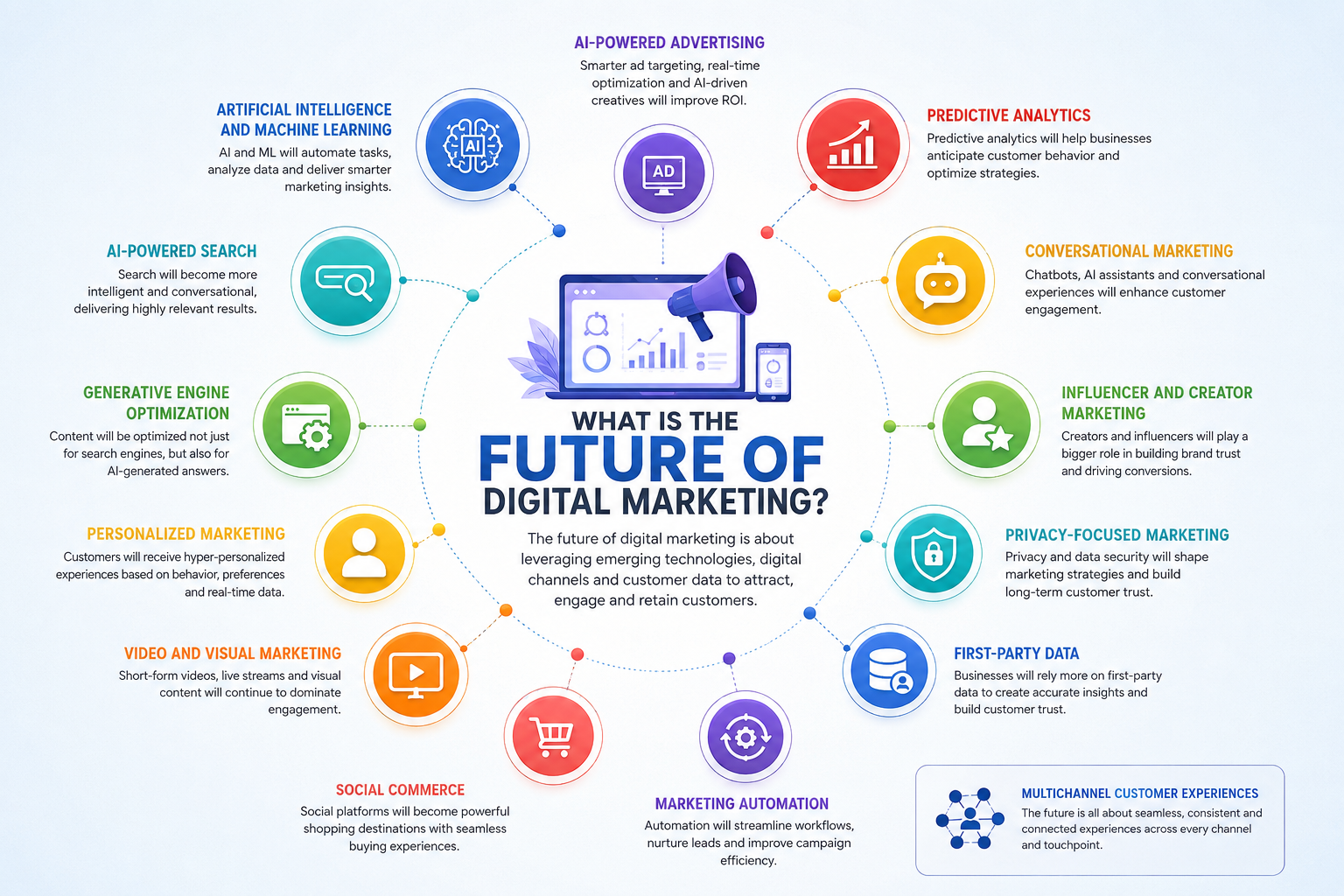
What Is the Future of Digital Marketing?
The future of digital marketing refers to the way businesses will use emerging technologies, digital channels and customer data to attract, engage and retain customers.
The major transformation can be understood through these developments:
- Artificial intelligence and machine learning
- AI-powered search
- Generative Engine Optimization
- Personalized marketing
- Video and visual marketing
- Social commerce
- Marketing automation
- First-party data
- Privacy-focused marketing
- Influencer and creator marketing
- Conversational marketing
- Predictive analytics
- AI-powered advertising
- Multichannel customer experiences
The important change is that these technologies are becoming interconnected rather than operating separately.
1. Artificial Intelligence Will Transform Marketing
AI is one of the most important forces influencing the future of digital marketing.
Businesses can already use AI to assist with:
- Content creation
- Keyword research
- Customer segmentation
- Email personalization
- Advertising optimization
- Chatbots
- Predictive analytics
- Social media content
- Customer support
- Campaign analysis
EICTA’s 2026 research describes AI as increasingly integrated into existing marketing platforms rather than functioning simply as an additional tool.
The biggest change is the shift from manual execution to AI-assisted execution.
Instead of spending hours preparing reports or creating multiple content variations, marketers can use AI to complete repetitive tasks while focusing on strategy, creativity and decision-making.
2. AI-Powered Search Will Change SEO
Search behavior is moving away from short keyword queries toward conversational questions.
Google’s 2026 Search developments allow users to ask more complex questions and search using different formats, including text, images, files and videos. Google also reports that AI Mode has passed one billion monthly users.
This creates a new opportunity for SEO.
Businesses should optimize content for:
- Traditional search results
- AI Overviews
- AI-powered search
- Conversational queries
- Voice search
- Visual search
- Long-tail questions
- Search intent
This does not mean traditional SEO is disappearing. Instead, SEO is becoming broader.
The objective is no longer only to rank a webpage. Businesses also want their information to become visible when customers use AI-powered search systems.
3. Generative Engine Optimization Will Grow
Generative Engine Optimization, commonly called GEO, focuses on improving a brand’s visibility within AI-generated answers.
Traditional SEO focuses primarily on search rankings, while GEO considers how information can be understood, retrieved and potentially referenced by AI systems.
A strong GEO strategy should include:
- Clear answers
- Reliable information
- Original research
- Expert insights
- Structured content
- Relevant statistics
- Strong topical authority
- Frequently asked questions
- Accurate business information
EICTA’s 2026 SEO research identifies AI-powered search and GEO as an increasingly important part of modern search optimization.
For businesses, the best approach is not to abandon SEO for GEO. Instead, they should build strong SEO fundamentals and make their content useful for both humans and AI systems.
4. Personalization Will Become More Advanced
Personalization has already become an important marketing strategy, but AI is taking it to another level.
Businesses can use customer information to create more relevant:
- Product recommendations
- Email campaigns
- Website experiences
- Advertisements
- Offers
- Content
- Customer journeys
According to HubSpot’s 2026 marketing research, AI-powered personalized content is the leading trend reported by marketers, and 93.2% of surveyed marketers say personalized or segmented experiences have generated more leads and purchases.
The future will therefore move from basic personalization toward increasingly individualized experiences.
However, personalization must be balanced with privacy. Customers need transparency about how their information is collected and used.
5. Video Marketing Will Continue to Grow
Video is expected to remain one of the most important digital marketing formats.
Businesses can use video for:
- Product demonstrations
- Tutorials
- Customer testimonials
- Educational content
- Brand storytelling
- YouTube marketing
- Short-form videos
- Live streaming
- Product reviews
Short-form content can be particularly useful for reaching audiences on social platforms.
AI is also making video production more efficient by helping marketers create scripts, captions, translations, summaries and different versions of the same content.
This means one long-form video can become:
YouTube video → Short → Reel → Blog article → Email → Social post
The ability to repurpose content efficiently can become a significant competitive advantage.
6. Social Media Will Become a Discovery Channel
Social media is no longer used only for communication and entertainment.
Consumers increasingly use social platforms to:
- Discover products
- Research brands
- Watch reviews
- Follow creators
- Learn about products
- Compare options
- Make purchases
The customer journey is becoming increasingly fragmented. Google describes today’s consumers as simultaneously searching, streaming, scrolling and shopping rather than following a simple linear funnel.
Therefore, businesses need to create content that works across different platforms instead of relying entirely on one channel.
7. Social Commerce Will Connect Content and Shopping
Social commerce is another important part of the future of digital marketing.
Instead of:
Social media → Website → Product page → Purchase
the journey can increasingly become:
Social media → Product discovery → Review → Product information → Purchase
Creator videos, product demonstrations and shoppable content can reduce the distance between discovery and purchase.
Google is also expanding commerce and shopping capabilities across Search and YouTube, showing how content discovery and commercial intent are becoming increasingly connected.
8. Marketing Automation Will Become More Intelligent
Marketing automation traditionally involved predefined workflows.
For example:
Customer signs up → Send email → Wait three days → Send another email
AI-powered automation can make these workflows more adaptive.
Future systems can potentially analyze:
- Customer behavior
- Purchase probability
- Engagement
- Campaign performance
- Customer interests
- Churn risk
and recommend appropriate actions.
This represents a shift from simple automation to marketing intelligence.
The marketer’s role becomes less about performing every repetitive task and more about setting objectives, reviewing AI recommendations and ensuring that campaigns support business goals.
9. First-Party Data Will Become More Valuable
Privacy concerns are changing how businesses collect and use customer information.
First-party data refers to information collected directly from customers through channels such as:
- Websites
- Email subscriptions
- CRM systems
- Customer accounts
- Loyalty programs
- Purchases
- Customer interactions
This information can help businesses understand their audiences without depending entirely on external advertising platforms.
The Gutenberg research also identifies first-party data and privacy-centric advertising as major future marketing considerations.
Businesses that build direct relationships with customers will have greater control over personalization and communication.
10. Influencer and Creator Marketing Will Expand
Consumers often look to creators for product recommendations, education and reviews.
The future of influencer marketing will therefore focus less on follower count and more on:
- Audience relevance
- Engagement
- Trust
- Conversion
- Content quality
- Brand compatibility
Businesses can collaborate with niche creators who have smaller but highly relevant audiences.
This can make creator marketing particularly useful for specialized products and regional markets.
Authentic customer-generated content can also help businesses build credibility.
11. Conversational Marketing Will Grow
Consumers increasingly expect businesses to provide fast answers.
AI-powered chatbots and conversational systems can assist with:
- Product questions
- Pricing information
- Recommendations
- Customer support
- Lead qualification
- Appointment requests
- Order-related questions
D.Y. Patil’s research highlights AI-powered conversational marketing and chatbots as important developments in the evolving digital marketing landscape.
The next step will be more intelligent conversations where AI can understand context instead of simply responding to predefined questions.
12. Voice and Visual Search Will Become More Important
Voice search was identified as a future trend by both Gutenberg and Geeta University, particularly because users increasingly ask questions using natural language.
Today, this trend is expanding into multimodal search.
Google reports that more than one in six AI Mode queries are entirely non-text, while Google Lens processes more than 25 billion visual searches each month.
This means businesses should pay attention to:
- Natural language
- Conversational content
- High-quality images
- Product information
- Video
- Structured data
- Local information
Search is no longer restricted to a keyboard.
13. AI-Powered Advertising Will Change PPC
Paid advertising is also becoming increasingly automated.
Google is integrating AI into Search campaigns to help advertisers find additional relevant queries and improve creative and landing-page matching. Its AI Max technology represents part of this transition.
AI-powered advertising can help with:
- Audience targeting
- Bid optimization
- Creative variations
- Search-query expansion
- Product recommendations
- Campaign analysis
However, marketers still need to define the right objectives and monitor campaign quality.
The future PPC specialist will increasingly become a strategist who manages the relationship between business goals and automated systems.
14. The Future of Digital Marketing in India
The future of digital marketing in India is particularly promising because businesses across industries are expanding their digital presence.
Important growth areas include:
- SEO
- Performance marketing
- Social media
- YouTube marketing
- Ecommerce marketing
- Influencer marketing
- AI marketing
- Content marketing
- Email marketing
- Local SEO
- Marketing automation
Google reports that Google and YouTube are present in 93% of Indian consumer journeys for discovering a new brand, product or retailer.
This demonstrates the importance of search and video in India’s digital economy.
The future of digital marketing in India will also be influenced by multilingual and regional content. Businesses can use AI to create and localize content for different Indian languages and audiences.
India’s growing AI ecosystem is another important factor. Google says its India AI initiatives include multilingual conversational tools and support for an increasingly agentic technology ecosystem.
For Indian businesses, combining AI with localized content, SEO, video and social media can create significant opportunities for growth.
15. Digital Marketing Careers Will Evolve
The future of digital marketing will also create new career opportunities.
Professionals will increasingly need skills in:
- SEO
- AI tools
- Content marketing
- Data analytics
- Social media
- Performance marketing
- Marketing automation
- Customer psychology
- Strategy
AI is likely to automate repetitive execution rather than eliminate the need for marketers altogether.
EICTA argues that AI changes the marketer’s role from simply executing tasks toward directing technology and connecting marketing activity with business objectives.
Therefore, continuous learning will be essential.
16. What Businesses Should Do Today
Businesses preparing for the future of digital marketing should focus on a strong foundation.
Build a strong website
- Improve page speed
- Ensure mobile responsiveness
- Strengthen technical SEO
- Create clear navigation
- Provide accurate information
Create better content
- Focus on search intent
- Answer customer questions
- Add original insights
- Use expert information
- Update outdated content
Adopt AI responsibly
- Use AI for research
- Automate repetitive work
- Personalize campaigns
- Analyze data
- Maintain human review
Diversify marketing channels
- SEO
- Social media
- Video
- Paid advertising
- Influencer marketing
- AI search
Build customer relationships
- Collect first-party data responsibly
- Develop email lists
- Use CRM systems
- Create loyalty programs
- Encourage repeat purchases
Learn Digital Marketing with Manjeet Madhukar, covering SEO, Social Media, Google Ads and practical marketing strategies.
Conclusion
The future of digital marketing will not be defined by one platform or technology. Instead, it will be shaped by the combined impact of AI, search, personalization, video, automation, social commerce, data and changing consumer behavior.
The biggest transformation is already visible in search. Consumers can ask more complex questions, use images and other formats, and receive increasingly intelligent answers.
For marketers, this means traditional SEO must evolve alongside AI-powered search. Content must become more useful and original, while brands need to build authority and trust.
The future of digital marketing in India is equally strong, with search, YouTube, ecommerce, AI and regional digital adoption creating new opportunities for businesses and professionals.
Ultimately, successful marketing will depend on combining AI efficiency with human creativity, expertise, trust and strategic thinking.
FAQs
1. What is the future of digital marketing?
The future of digital marketing will be influenced by AI, AI-powered search, personalization, automation, video, social commerce, first-party data and conversational customer experiences.
2. How will AI change digital marketing?
AI will help marketers automate repetitive tasks, analyze data, personalize customer experiences, create content and optimize advertising campaigns. Human strategy and quality control will remain important.
3. What is the future of digital marketing in India?
The future of digital marketing in India includes strong opportunities in SEO, performance marketing, social media, video, ecommerce, AI, content marketing, influencer marketing and marketing automation.
4. Will AI replace digital marketers?
AI is more likely to change marketing jobs than completely replace digital marketers. Professionals who understand AI and combine it with strategy, creativity and business knowledge will be better prepared for the future.
5. Is SEO still important in the future?
Yes. SEO remains important, but it is evolving to include AI-powered search, conversational queries, visual search and broader search visibility.
6. What digital marketing skills will be important in the future?
Important skills include SEO, AI literacy, data analytics, content creation, social media, performance marketing, automation, customer psychology and strategic thinking.
7. Why is personalization important in digital marketing?
Personalization helps businesses deliver more relevant content, products and experiences. AI is making it easier to personalize marketing at scale.
8. What role will video play in future marketing?
Video will remain important for education, entertainment, product demonstrations, brand storytelling, reviews and social commerce. Businesses can also repurpose long-form videos into multiple marketing formats.