
A career in digital marketing has become an attractive option for students, graduates, working professionals and people planning a career change. As businesses increasingly use websites, search engines, social media, online advertising and e-commerce platforms to reach customers, the demand for skilled digital marketing professionals continues to increase.
Digital marketing is much more than managing social media posts. It includes search engine optimization (SEO), paid advertising, content marketing, social media marketing, email marketing, analytics, e-commerce and customer engagement.
Google’s current Digital Marketing & E-commerce Certificate focuses on skills such as digital marketing strategy, search, content marketing, email marketing, analytics, e-commerce and customer loyalty. It also states that previous experience is not required for its entry-level program.
For anyone considering a career in digital marketing, understanding the available job roles, skills, salary expectations, education requirements and future opportunities is important.
What Is a Career in Digital Marketing?
Digital marketing involves promoting products, services or brands through digital channels. Businesses use digital marketing to attract visitors, generate leads, increase sales and maintain relationships with customers.
A professional working in this field may optimize a website for Google, manage paid advertising campaigns, create content, handle social media, analyze campaign data or manage an online store.
This makes a career in digital marketing a combination of marketing, technology, creativity and analytics.
One of its biggest advantages is that professionals do not have to follow a single career path. They can specialize in SEO, performance marketing, social media, content, email marketing, analytics or e-commerce and gradually move into managerial or strategic positions.
Why Choose a Career in Digital Marketing?
There are several reasons why digital marketing is becoming an attractive profession in India.
First, businesses across industries need digital visibility. E-commerce companies, educational institutions, healthcare businesses, technology companies, financial services, real estate companies, startups and local businesses all use digital channels to reach potential customers.
Second, digital marketing offers different types of jobs. Indeed’s current India guide identifies 16 digital marketing-related career options, covering areas such as SEO, graphic design, social media, content and other digital roles.
Third, professionals can work in different environments. They can join an agency, work for an in-house marketing team, work remotely, freelance for clients or eventually start their own agency.
The field is also changing rapidly with AI, automation, analytics and new search technologies, creating opportunities for professionals who continuously upgrade their skills.
Scope of Digital Marketing in India
The scope of digital marketing extends across almost every industry that uses online communication or sells products and services.
Businesses need professionals who can improve organic search visibility, create valuable content, manage advertising campaigns, generate leads and measure marketing performance.
The growth of e-commerce has further increased demand for professionals who understand online customer journeys. Google’s current digital marketing program includes building and managing e-commerce stores, analyzing performance and developing customer loyalty.
Current 2026 career research also highlights opportunities in industries including e-commerce, healthcare, education, finance, real estate, manufacturing and hospitality.
This means a career in digital marketing is not restricted to digital agencies. Professionals can build careers within companies belonging to almost any sector.
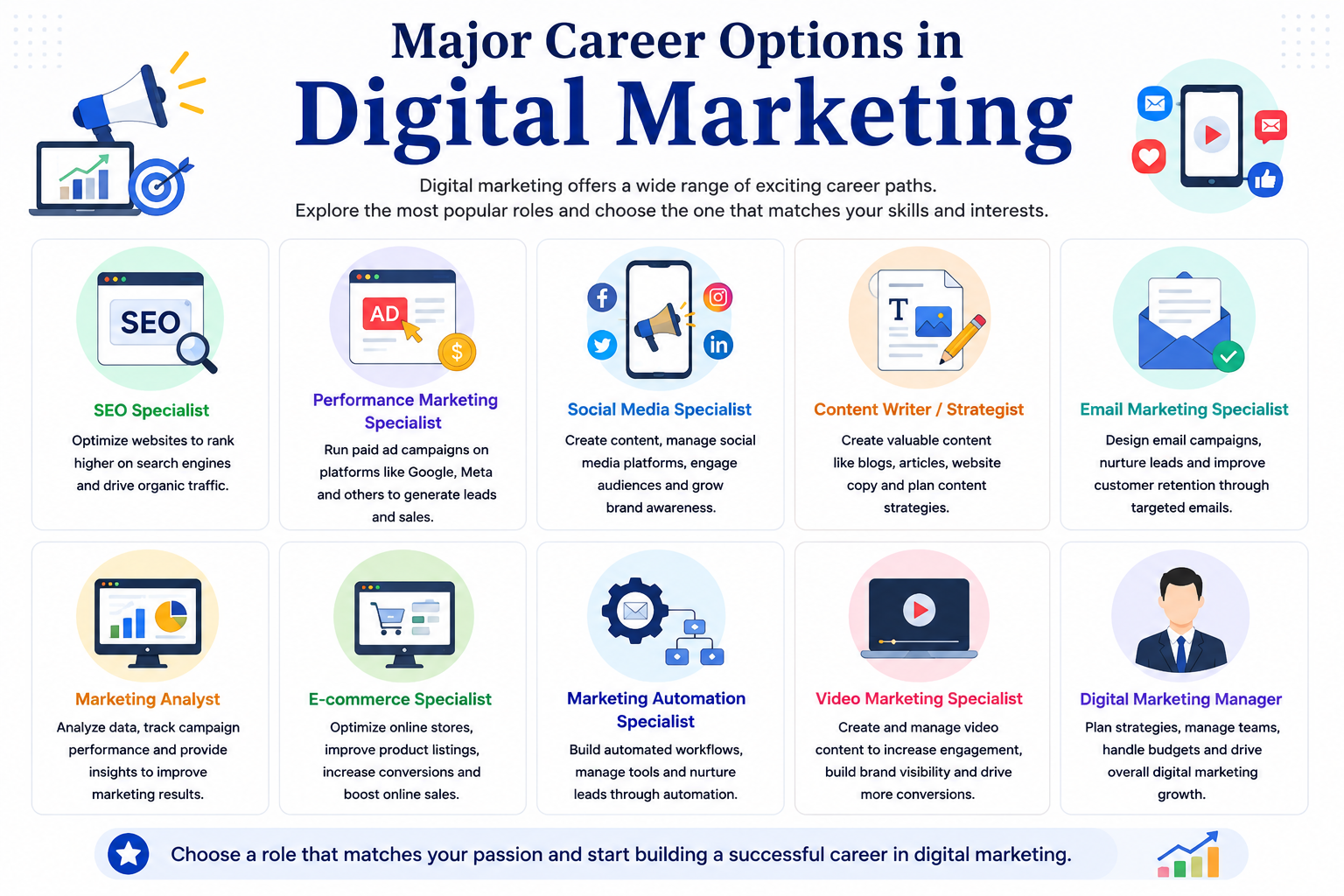
Major Career Options in Digital Marketing
One of the biggest advantages of this field is the number of specializations available.
SEO Specialist
SEO specialists help websites improve their visibility in organic search results. Their work can include keyword research, on-page SEO, technical optimization, internal linking, content planning and performance analysis.
Indeed reports that SEO specialists use techniques designed to increase website visibility, traffic and conversions and rely on keyword research and analytical data.
Performance Marketing Specialist
Performance marketers manage paid campaigns on platforms such as Google Ads and Meta Ads. Their focus is usually on measurable outcomes such as leads, sales, conversions and return on advertising spend.
This is a suitable specialization for people who enjoy numbers, testing and performance analysis.
Social Media Specialist
Social media professionals develop content strategies, manage social channels, engage with audiences and monitor performance.
Modern social media marketing involves much more than publishing posts. Professionals need to understand audiences, content formats, platform trends and business objectives.
Content Writer or Strategist
Content professionals create blogs, website pages, social media content, email campaigns, product descriptions and other marketing materials.
Content strategists focus on the bigger picture, including audience needs, search intent, content planning and business objectives.
Email Marketing Specialist
Email marketers create campaigns designed to attract, nurture and retain customers. They may manage newsletters, promotional emails, automated workflows and customer segmentation.
Marketing Analytics Specialist
Analytics professionals use marketing data to understand campaign performance and customer behavior. Google includes marketing analytics and measurement as a core component of its current program.
E-commerce Specialist
E-commerce professionals help businesses manage online stores, product listings, customer experiences and online sales. This role combines marketing, technology, customer behavior and business strategy.
Digital Marketing Career Salary in India
The digital marketing career salary depends on several factors, including experience, specialization, location, company size, industry and practical skills.
According to Indeed’s current India data, the national average salary is approximately ₹3.07 lakh per year for SEO specialists, ₹3.09 lakh for social media specialists and ₹3.34 lakh for digital marketers. Other specialized roles can have higher averages; for example, Indeed lists approximately ₹4.69 lakh for content strategists, ₹5.44 lakh for e-commerce managers and ₹5.88 lakh for PPC managers.
These figures are averages rather than guaranteed salaries. Individual salaries can vary considerably.
Current 2026 career research from EICTA gives broader salary ranges based on experience, with freshers typically around ₹2.8–5 lakh annually, junior professionals around ₹5–9 lakh, mid-level professionals around ₹9–15 lakh and senior professionals around ₹15–25 lakh.
Experience |
Approximate Salary Range |
Fresher |
₹2.8–5 LPA |
Junior Professional |
₹5–9 LPA |
Mid-Level |
₹9–15 LPA |
Senior Professional |
₹15–25 LPA |
Leadership |
₹25 LPA+ |
The digital marketing career salary can increase as professionals develop specialized expertise and demonstrate measurable business results.
Skills Required for a Career in Digital Marketing
Building a successful career in digital marketing requires both technical and soft skills.
Important technical skills include:
- SEO and keyword research
- Google Ads and paid advertising
- Social media marketing
- Content marketing
- Email marketing
- Google Analytics
- Search Console
- Conversion optimization
- E-commerce
- Marketing automation
- AI marketing tools
Google’s current program specifically teaches areas including content marketing, email marketing, marketing analytics, e-commerce and customer engagement, along with widely used tools and platforms.
Soft skills are equally important. Communication, creativity, analytical thinking, adaptability and problem-solving help professionals perform better and progress into senior roles.
Employers increasingly want candidates who can explain results, rather than simply describe the tasks they performed.
Is a Degree Required for Digital Marketing?
A specific digital marketing degree is not always required.
Google’s current Digital Marketing & E-commerce Certificate states that no previous experience or specific tool knowledge is required for its program.
However, educational qualifications can still be useful because many employers have their own hiring requirements.
More importantly, candidates should develop practical experience. A portfolio containing SEO projects, content campaigns, social media work, advertising exercises or analytics reports can help demonstrate actual skills.
A certificate can support your profile, but practical knowledge and measurable results are often more valuable than certification alone.
Career in Digital Marketing After 12th
Students can start preparing for a career in digital marketing after Class 12.
A practical approach is to pursue graduation while learning digital marketing alongside formal education. Students can explore SEO, social media, content writing, paid advertising and analytics.
Creating a personal website or blog is an excellent way to practice. Students can also manage a small social media project, complete internships or create sample marketing campaigns.
Entry-level positions can include digital marketing executive, SEO trainee, content executive, social media executive or PPC assistant.
The objective should be to develop practical skills rather than expecting a high salary immediately after completing a course.
How to Start a Career in Digital Marketing
If you want to start a career in digital marketing, follow a structured approach.
Begin by understanding the fundamentals of digital marketing and how different channels work together.
Next, explore different specializations and select one area in which you want to develop deeper expertise.
Learn the tools used in your chosen field. For example, SEO professionals can learn Google Search Console and analytics tools, while performance marketers should understand advertising platforms and conversion tracking.
After learning the basics, create real projects. Build a website, perform keyword research, conduct an SEO audit, create a social media strategy or develop a sample advertising campaign.
Finally, create a portfolio and start applying for internships and entry-level positions.
Indeed also recommends combining learning, networking, staying updated with industry trends, certifications and hands-on practice when developing digital marketing skills.
Want to learn digital marketing from an experienced mentor? Check out Manjeet Madhukar’s practical guides and resources to improve your SEO, social media marketing, content marketing and overall digital marketing skills.
Digital Marketing Career Growth
A typical career path can begin with an internship or entry-level executive role.
After gaining experience, professionals can become SEO specialists, PPC specialists, social media specialists, content strategists or analytics professionals.
With stronger skills and experience, they can move into positions such as digital marketing manager, performance marketing manager or digital strategist.
At senior levels, professionals can progress toward roles such as Head of Digital Marketing, Growth Manager, Marketing Director or CMO.
Career growth depends not only on years of experience but also on specialization, leadership ability and the ability to generate measurable business results.
Freelancing in Digital Marketing
Freelancing provides another option for professionals who want flexibility.
Experienced marketers can offer SEO, social media management, content writing, paid advertising, email marketing or analytics services to multiple businesses.
However, freelancing requires more than technical marketing knowledge. Freelancers must also develop communication, sales, project management, pricing and client relationship skills.
With experience, a freelancer can eventually develop a consulting business or digital marketing agency.
Future of Digital Marketing in India
The future of digital marketing will be influenced by artificial intelligence, automation, analytics, e-commerce, personalization and changing search behavior.
AI is already becoming part of professional marketing workflows. Google’s current curriculum includes AI-related applications alongside traditional marketing skills.
This does not mean that AI will eliminate digital marketing careers. Instead, marketers will increasingly use AI to perform repetitive tasks, analyze information, generate ideas and improve productivity.
Professionals who combine marketing fundamentals with analytics, technology and AI skills are likely to be better prepared for the changing industry.
Current 2026 research also emphasizes the importance of measurable results, specialization and continuous learning for professionals entering the field.
Conclusion
A career in digital marketing offers diverse opportunities for students, freshers, graduates, working professionals and career changers. From SEO and performance marketing to content, social media, analytics and e-commerce, professionals can choose a specialization that matches their interests and strengths.
The digital marketing career salary varies according to experience, skills, specialization, location and company. While entry-level professionals generally begin with moderate salaries, specialized skills and proven results can lead to stronger career growth and higher compensation.
The best way to build a successful career is to focus on practical knowledge rather than certificates alone. Learn the fundamentals, specialize in a high-value area, practice with real projects, build a portfolio and continue learning as technology changes.
With AI, analytics and digital commerce reshaping the industry, digital marketing is likely to remain an important career field for professionals who are willing to adapt and continuously improve their skills.
FAQs About Career in Digital Marketing
1. Is digital marketing a good career in India?
Yes. Digital marketing offers opportunities across industries and includes multiple specializations such as SEO, paid advertising, content, social media, analytics and e-commerce.
2. What is the digital marketing career salary for freshers?
Freshers can generally expect approximately ₹2.8–5 lakh per year, although the actual offer depends on skills, location, company and role.
3. Can I start digital marketing after 12th?
Yes. Students can learn digital marketing after Class 12 while pursuing graduation and can gain experience through projects and internships.
4. Is coding necessary for digital marketing?
No. Advanced coding is not required for most digital marketing jobs. However, basic technical knowledge can be useful, particularly for SEO and analytics.
5. Which digital marketing job is best for freshers?
SEO executive, content executive, social media executive, PPC assistant and digital marketing executive are common starting positions.
6. Can I work as a freelance digital marketer?
Yes. After gaining sufficient expertise and practical experience, professionals can provide digital marketing services to multiple clients as freelancers or consultants.
7. Will AI replace digital marketing professionals?
AI will automate some repetitive tasks, but professionals will still be needed for strategy, creativity, customer understanding, analysis and business decision-making.
8. What skills should I learn for a digital marketing career?
Start with SEO, content marketing, social media, paid advertising, analytics and email marketing. Then specialize in one area and add AI and automation skills.
9. Does digital marketing have a future?
Yes. As businesses continue using digital channels for customer acquisition, sales and communication, professionals with updated skills should continue to find opportunities.
10. How can I get my first digital marketing job?
Learn the fundamentals, complete practical projects, build a portfolio, obtain relevant certifications and apply for internships or entry-level positions. Demonstrating what you can actually do is more powerful than relying only on a certificate.