

If you have just started your programming journey, you have probably typed “which language is best for DSA” into Google more than once, hoping for one final answer. The truth is, there isn’t a single winner for everyone. The right choice depends on your background, your goals, and how comfortable you already are with a language. This guide will help you understand your options clearly so you can stop worrying and start learning.
Why People Keep Asking Which Language Is Best for DSA
Almost every student preparing for coding interviews goes through the same confusion. Most YouTube tutorials teach in C++ or Java. Some forums say Python is too slow. Others say JavaScript works fine if you already use it. This mix of opinions is exactly why so many beginners keep searching for which language is best for DSA instead of simply starting to learn.
Here is the honest answer: DSA, or Data Structures and Algorithms, is not tied to any one language. It is a way of thinking about problems and solving them efficiently. The language is just the tool you use to express that thinking. Once you understand this, the pressure of finding the “perfect” language disappears, and the real question becomes which language will help you learn fastest and perform best under pressure.
Understanding the Four Common Choices
Four languages usually come up when people discuss which language is best for DSA: C++, Java, Python, and JavaScript.
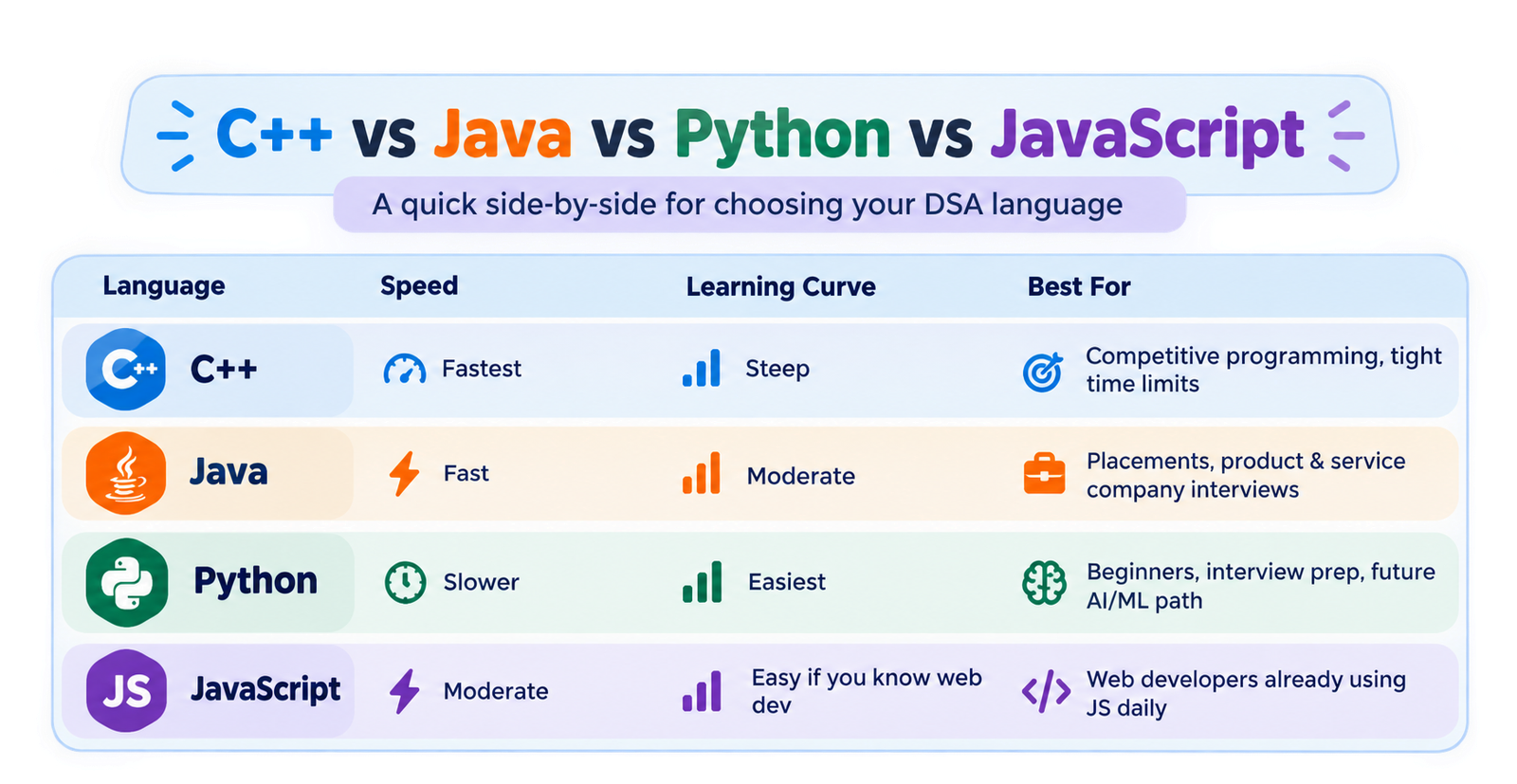
C++ is a favorite among competitive programmers because of its Standard Template Library, or STL, which gives ready-made tools like vectors, maps, sets, and priority queues. It also runs very fast due to low-level memory control, which matters in contests with strict time limits. The downside is a steeper learning curve, since concepts like pointers and manual memory handling can feel overwhelming at first.
Java sits comfortably in the middle. It follows clear object-oriented principles and is widely used by companies for interviews and production systems. Its Collections Framework offers strong built-in data structures, and its strict typing habits help catch mistakes early, which is useful while learning. It involves more boilerplate code than Python, but that structure often makes debugging easier for beginners.
Python is usually the language beginners fall in love with first. Its clean syntax means you spend less time fighting the language and more time understanding the logic behind a data structure. Built-in libraries like collections and heapq make it easy to implement stacks, queues, and heaps without much extra effort. This is also why Python suits people planning to move toward AI and machine learning later. The one thing to watch is speed, since Python is generally slower than C++ or Java in tight time-limit situations.
JavaScript has become a realistic option too, especially for web developers who already use it daily. Learning a whole new language just for DSA can slow you down, so practicing in a language you already know lets you focus purely on logic. Modern JavaScript also supports structures like Map and Set, covering most interview needs.
So, Which Language Is Actually Best for DSA?
If you are still waiting for one clear winner, here is the rule that experienced learners keep repeating: the language you already know reasonably well is usually the best language for you to learn DSA in. If you already know Python, continue with Python. If you already know Java, continue with Java. The goal of DSA is to strengthen your problem-solving ability, not to learn a brand-new language at the same time.
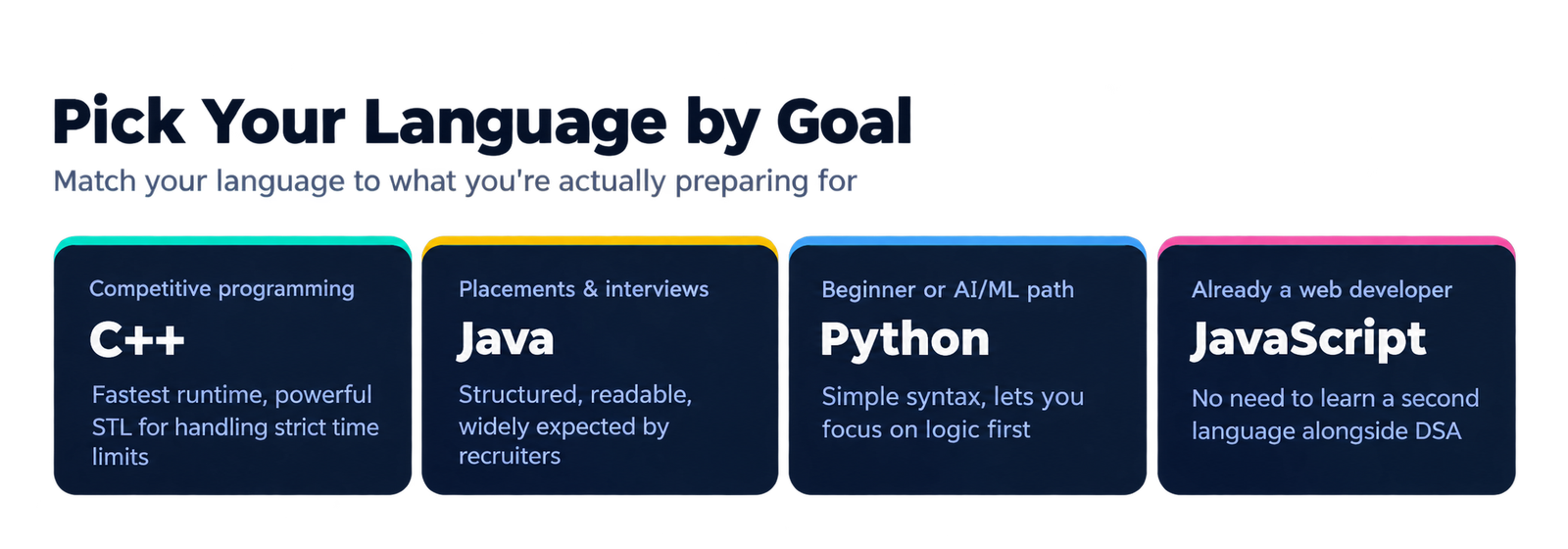
This idea answers a big part of the question of which language is best for DSA for most learners. Still, some goals do call for a specific choice. For competitive programming, where solutions are judged strictly on speed, C++ is the safer option. For interviews at product-based or service-based companies, Java offers structure that reads well. For beginners who want to grasp logic before syntax, or for those heading toward AI and machine learning, Python is usually the smarter path. And if you are already comfortable in web development, JavaScript is a perfectly valid way to learn DSA too.
Will You Be at a Disadvantage With Python or JavaScript?
This fear deserves a direct answer: no, choosing Python or JavaScript instead of C++ or Java does not put you at a real disadvantage for most interviews. Companies mainly care about your ability to think clearly and write a correct, efficient solution. Language is usually secondary, as long as the platform allows it and you can explain your reasoning well. The only place where language truly matters is in highly competitive contests with very tight time limits, where C++’s raw speed becomes important.
A Few Practical Tips Once You Choose
Once you pick a language, small habits make the journey smoother. In Python, avoid list.pop(0) for queues since it is slow; use collections.deque instead. In Java, prefer ArrayDeque over the older Stack or LinkedList classes for better performance. In C++, take time to genuinely understand STL container behavior instead of memorizing syntax. Whichever language you pick, avoid switching every few weeks. Repeated switching resets your familiarity with syntax and libraries, which hurts your progress far more than any small performance gap between languages.
“Once you’ve picked a language, the best way to build confidence is regular practice. Platforms like LeetCode let you solve problems in your chosen language and see exactly how interviewers evaluate your code.”
“Once you’ve picked your language, the next step is following a clear learning path. Check out our complete DSA beginner roadmap to know exactly what to study first.”
Conclusion
In the end, the answer to which language is best for DSA is less about the language itself and more about consistency and comfort. C++ offers speed for competitive programming, Java offers structure for interviews, Python offers simplicity and pairs well with future goals like AI, and JavaScript offers convenience for web developers. None of these choices is wrong. What matters far more is how regularly you practice and how well you understand each concept. Pick a language you are comfortable with, commit to it, and focus your energy on becoming a strong problem solver rather than continuing to search for a perfect answer that doesn’t really exist.
Frequently Asked Questions
- Which language is best for DSA for complete beginners?
Python is usually recommended for beginners because its simple syntax lets you focus on logic rather than complicated code. - Is C++ necessary for DSA, or can I skip it?
C++ is not compulsory. It matters mainly if you are aiming for competitive programming or speed-heavy roles. - Is Python enough for coding interviews?
Yes, most companies accept Python for interviews. Learn tricks like using heapq for heaps and deque for queues to avoid slowdowns. - Should I learn DSA in Java if I want a product-based company job?
Java is a strong choice for such interviews because of its structured syntax and powerful collections framework. - Can I learn DSA using JavaScript if I am a web developer?
Yes, JavaScript supports all major data structures and algorithms needed for interviews, especially if you already use it regularly. - Will choosing Python instead of C++ put me at a disadvantage?
For most standard interviews, no. Companies focus on problem-solving, not the specific language, except in strict time-limited contests. - Should I switch languages halfway through my DSA preparation?
It’s best to avoid switching once you’re deep into preparation, since it slows progress by forcing you to relearn syntax. - Does learning DSA in Python help with AI and machine learning later?
Yes, since Python is widely used in AI and machine learning, learning DSA in it gives you an added advantage for that path. - What is the most common mistake students make when choosing a DSA language?
Choosing a language simply because toppers use it, instead of picking one they’re personally comfortable with. - Do interviewers care which language I use to solve DSA problems?
Most care more about your problem-solving ability and understanding of time and space complexity than the language itself.

