
Choosing the right trading app for beginners can feel confusing, especially when dozens of platforms offer different features, pricing plans, charts, research tools and investment options. A good app should do more than allow you to buy and sell stocks. It should help you understand the market, manage your portfolio, monitor orders and access useful information in a simple and secure way.
For new investors in India, the right platform depends on your experience, investment goals, preferred products and willingness to learn. SEBI provides resources for investors to verify registered intermediaries and authorised mobile trading applications, making regulatory verification an important part of selecting a platform.
What Is a Trading App?
A trading app is a mobile or web-based platform that allows investors to access financial markets. Depending on the broker, users may be able to buy and sell stocks, invest in ETFs, participate in IPOs, invest in mutual funds and access derivatives.
A trading app for beginners should have an easy-to-understand interface where important information such as holdings, orders, available funds and portfolio performance can be found without unnecessary complexity.
Before opening an account, beginners should understand the difference between a trading account and a Demat account. A trading account is generally used to place transactions, while a Demat account holds securities electronically.
How to Choose a Trading App for Beginners
There is no single platform that is perfect for every investor. The trading app for beginners should be selected according to individual requirements rather than popularity alone.
1. Look for an Easy-to-Use Interface
A simple interface is particularly important for first-time investors. The app should make it easy to:
- Search for stocks
- Create watchlists
- Place orders
- View holdings
- Track profit and loss
- Check available funds
- Review previous transactions
A complicated dashboard can make the learning process more difficult.
2. Check Brokerage and Other Charges
Pricing is another important consideration. However, beginners should not select a platform solely because it advertises low or zero brokerage.
Trading-related costs can include brokerage, securities transaction tax, GST, exchange charges, stamp duty, DP charges and other applicable fees. Therefore, always review the broker’s current pricing schedule before opening an account.
The best trading app for beginners should provide transparent information about its charges so users can understand the actual cost of their transactions.
3. Verify Security and Regulation
Security should be one of the first things a beginner checks.
SEBI maintains information about registered stock brokers and also provides links to authorised mobile trading applications through its investor-support portal.
Before downloading an app, check:
- The broker behind the application
- SEBI registration
- Official website
- Authorised app details
- Privacy and security practices
- Customer-support channels
Never install a trading application from an unknown APK, suspicious advertisement or unverified link.
4. Consider Educational Resources
A beginner should not start trading simply because an app makes buying and selling easy.
Look for educational resources explaining:
- Stock-market basics
- Market and limit orders
- Risk management
- Portfolio management
- Technical and fundamental analysis
- Trading terminology
A platform that supports learning can be more useful than one that only provides advanced charts.
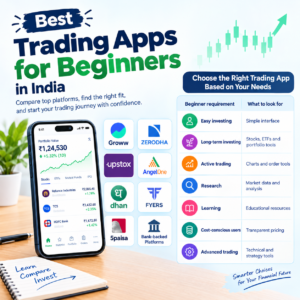
Best Trading Apps for Beginners in India
Several well-known Indian brokerage platforms compete for retail investors, including Groww, Zerodha, Upstox, Angel One, Dhan, FYERS, 5paisa and bank-backed platforms.
Rather than identifying one universal winner, compare platforms according to your requirements.
Beginner requirement |
What to look for |
Easy investing |
Simple interface |
Long-term investing |
Stocks, ETFs and portfolio tools |
Active trading |
Charts and order tools |
Research |
Market data and analysis |
Learning |
Educational resources |
Cost-conscious users |
Transparent pricing |
Advanced trading |
Technical and strategy tools |
Current industry coverage also shows that specialised brokers are gaining users as experienced traders seek platforms designed around particular trading and investment needs.
Therefore, the trading app for beginners that works well for a long-term investor may not be the best choice for someone interested in active trading.
Trading App vs Investing App
Many beginners use the terms “trading” and “investing” interchangeably, but they can involve different approaches.
Investing generally involves holding assets for a longer period and focusing on long-term financial goals.
Trading usually involves more frequent buying and selling based on price movements, market conditions or specific strategies.
If your primary goal is long-term wealth creation, you may not need all the advanced tools offered by an active-trading platform.
Should Beginners Start With Intraday or F&O?
Beginners should understand the risks before moving into short-term or leveraged products.
Intraday trading involves buying and selling within the same trading session. Futures and options are derivatives and can be considerably more complex.
Recent SEBI data reported that 87.7% of individual equity-derivatives traders incurred losses in FY26, while aggregate individual trader losses were approximately ₹916.85 billion.
This does not mean every individual will lose money, but it highlights why beginners should learn about risk, leverage, position sizing and the characteristics of derivatives before participating.
A responsible trading app for beginners should therefore be viewed as a learning and execution tool—not as a shortcut to guaranteed profits.
Are Zero-Brokerage Trading Apps Really Free?
Zero brokerage does not necessarily mean zero transaction costs.
Depending on the transaction, investors may still encounter statutory and regulatory charges. The exact cost structure varies by broker and product.
When comparing a trading app for beginners, check the complete pricing structure instead of looking only at the headline brokerage rate.
Pay particular attention to:
- Equity delivery charges
- Intraday charges
- F&O charges
- AMC
- DP charges
- GST
- STT
- Exchange transaction charges
- Stamp duty
Pricing can also change, so information should be checked on the broker’s official website before making a decision.
How to Start Using a Trading App
A simple beginner journey generally looks like this:
Step 1: Learn basic stock-market concepts.
Step 2: Research registered brokers.
Step 3: Select an appropriate platform.
Step 4: Download the official application.
Step 5: Complete KYC and account-opening requirements.
Step 6: Understand the applicable charges.
Step 7: Add funds through the supported process.
Step 8: Create a watchlist and observe the market.
Step 9: Learn different order types.
Step 10: Start only with products and amounts you understand.
SEBI’s investor-support portal provides links to authorised mobile apps and other investor resources, which can help users verify the platform they intend to use.
If you want to build practical digital marketing skills, you can learn from Manjeet Madhukar, who provides professional digital marketing training along with real-world digital marketing services. His guidance can help you understand SEO, social media marketing, paid advertising and other essential skills while gaining practical industry knowledge.
Common Mistakes Beginners Should Avoid
Even the best trading app for beginners cannot protect users from poor financial decisions.
Avoid these common mistakes:
- Choosing an app only because of low brokerage.
- Trading without understanding how orders work.
- Following social-media stock tips blindly.
- Starting with complex derivatives.
- Overtrading.
- Ignoring transaction costs.
- Using excessive leverage.
- Expecting guaranteed returns.
- Sharing OTPs, passwords or PINs.
- Downloading applications from unofficial sources.
Recent developments in India’s market structure also demonstrate why investors should stay informed about regulatory changes. SEBI has been reviewing aspects of derivatives settlement following volatility associated with the new Closing Auction Session introduced in August 2026.
What Features Should a Beginner Prioritize?
When comparing a trading app for beginners, focus on practical features rather than the largest number of tools.
A useful platform should ideally provide:
- Simple navigation
- Reliable order placement
- Portfolio tracking
- Clear transaction history
- Market information
- Basic charts
- Transparent charges
- Security features
- Customer support
- Educational material
Advanced tools can become useful as your knowledge grows, but beginners don’t necessarily need every indicator, automation feature or complex trading strategy on day one.
Frequently Asked Questions
What is the best trading app for beginners?
The best trading app for beginners depends on individual requirements. Compare ease of use, security, charges, investment options, education, research tools and customer support before selecting a platform.
Is a trading app safe for beginners?
A trading app can provide access to regulated market infrastructure, but market investments themselves carry risk. Verify the broker’s registration and authorised application details before opening an account. SEBI provides resources for checking registered intermediaries and authorised mobile apps.
How much money do I need to start trading?
There is no universal minimum amount for all types of investing or trading. The amount depends on the security, transaction costs and strategy. Beginners should avoid committing money they cannot afford to lose.
Are zero-brokerage trading apps completely free?
No. Zero brokerage for a particular transaction does not necessarily eliminate statutory, regulatory or other applicable charges.
Should beginners trade options?
Options can be complex and involve significant risk. Beginners should understand derivatives, leverage, margin and risk management before considering them.
How can I check whether a trading app is legitimate?
Identify the broker operating the application and verify its registration and authorised app information through official regulatory or exchange resources. SEBI provides an authorised mobile-app directory for registered intermediaries.
Is trading better than long-term investing?
Neither is automatically better. The appropriate approach depends on your financial goals, risk tolerance, knowledge and investment timeframe.
Conclusion
Choosing a trading app for beginners should be based on more than advertisements, popularity or low brokerage. Beginners should compare usability, pricing, security, educational resources, research tools and available investment products before making a decision.
Most importantly, remember that an app is simply a tool. It cannot guarantee profits or remove market risk. Start by learning the basics, verify the broker, understand the charges and avoid complex products until you understand how they work.
A thoughtful comparison can help you find a trading app for beginners that fits your current knowledge while giving you room to develop as an investor or trader. Always check the latest official broker and regulatory information before opening an account.