
Digital marketing has become one of the most effective ways for businesses to reach, engage and convert customers. From search engines and social media to email, paid advertising and influencer campaigns, businesses can use multiple digital channels to connect with their target audience.
Studying digital marketing examples is useful because it shows how marketing concepts work in real situations. Instead of learning only from theory, businesses can examine what successful brands did, why their campaigns worked and how similar strategies can be adapted to different industries.
Modern digital marketing combines channels, customer data, creative content and measurable objectives. Amazon Ads, for example, recommends beginning with audience research and objectives before selecting channels, creating content and measuring campaign performance.
The following examples demonstrate different approaches that businesses can learn from.
What Is Digital Marketing?
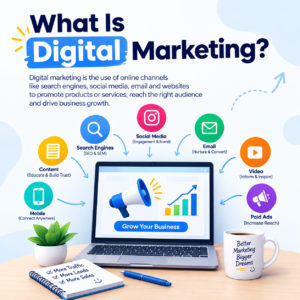
Digital marketing refers to promoting products, services or brands through digital channels such as websites, search engines, social media, email, mobile applications, online advertising and digital content.
Unlike traditional marketing, digital campaigns can provide detailed information about audience behavior and campaign performance. Businesses can measure metrics such as website traffic, clicks, engagement, leads, conversions and return on advertising spend.
Digital marketing can include:
- Search engine optimization (SEO)
- Social media marketing
- Content marketing
- Email marketing
- Pay-per-click advertising
- Influencer marketing
- Video marketing
- Affiliate marketing
- Mobile marketing
- User-generated content
- Personalization and AI marketing
Adobe also presents digital campaigns as broader initiatives that can combine paid, owned and earned media rather than relying on a single advertising channel.
15 Digital Marketing Examples to Learn From
1. Canva – SEO and Content Marketing
Canva is a strong example of using SEO-driven content and landing pages to capture people searching for design-related solutions. Its approach demonstrates how businesses can create pages around specific user needs and search queries.
Instead of targeting only branded searches, businesses can create useful pages around topics such as templates, design tools and specific use cases.
Key lesson: Identify what your customers search for and create useful content that answers those needs.
SEO remains particularly valuable because high-intent organic traffic can continue bringing visitors after content has been published. Current SEO research also emphasizes connecting content with revenue-focused keywords rather than treating SEO as a checklist.
2. Zomato – Social Media Marketing
Zomato is one of India’s most recognizable examples of social media marketing. Its online communication frequently uses humour, cultural references and timely conversations instead of relying entirely on conventional advertisements.
The strategy demonstrates the importance of developing a recognizable brand voice and creating content that people want to share.
Key lesson: Social media content does not always need to sell directly. Entertaining and relevant content can strengthen brand awareness and engagement.
Indian marketing research also frequently identifies Zomato as an example of combining social media, content and location-focused SEO.
3. Spotify – Personalized Marketing
Spotify Wrapped is one of the best-known examples of personalized digital marketing. The service turns individual listening behavior into personalized summaries that users can share with their friends and followers.
The important idea is that customers become part of the distribution process.
Data → personalization → customer sharing → additional brand exposure
Key lesson: Customer data can be transformed into useful, entertaining and shareable experiences.
4. Dove – User-Generated Content
Dove has used user-generated content, hashtag campaigns and social videos to connect its brand with conversations around beauty and self-image. Shopify highlights Dove as an example of putting customer stories and social participation alongside product promotion.
Key lesson: Giving customers a voice can make campaigns feel more authentic than traditional product-focused advertising.
5. CRED – Influencer Marketing
CRED has become known for combining celebrities, influencers and humour in its campaigns. Rather than simply presenting a product advertisement, its campaigns often turn personalities and entertainment into the central attraction.
Key lesson: Influencer marketing works best when the content fits the personality of both the creator and the audience.
For Indian businesses, this approach can also work with niche creators rather than only expensive celebrities.
6. Nykaa – Content, Email and Personalization
Nykaa provides an example of combining e-commerce with educational and personalized marketing. Beauty customers often need information before making a purchase, so tutorials, product information, creator content, recommendations and promotional communication can work together.
Recent Indian marketing research also highlights Nykaa’s combination of SEO, social media, content and personalization.
Key lesson: Content can reduce customer uncertainty and support the buying decision.
7. HubSpot – Content Marketing
HubSpot is widely associated with educational content marketing. Instead of promoting software through advertisements alone, it produces resources that answer questions about marketing, sales, CRM and business growth.
This creates a journey:
Search → useful content → trust → lead → product
Key lesson: Educational content can attract potential customers before they are ready to make a purchase.
8. GoPro – User-Generated Video
GoPro provides another useful example of customer-generated content. Customers record experiences using GoPro products and share those experiences online.
This gives the company a continuous source of authentic visual content.
Key lesson: If customers naturally create content while using your product, encourage them to share it.
9. Samsonite – Search Engine Marketing
Samsonite demonstrates how keyword research can inform paid search campaigns. Instead of showing advertisements randomly, businesses can identify what potential customers search for and align advertising messages with those searches.
Shopify specifically identifies Samsonite as an example of search engine marketing based on understanding user search behavior and matching advertisements to relevant queries.
Key lesson: Effective PPC starts with customer intent, not simply advertising budget.
10. CeraVe – Storytelling and Influencer Marketing
CeraVe created a memorable campaign around actor Michael Cera, using a humorous story that suggested he was connected to the brand’s creation. The campaign developed across social conversations, influencers and media before the final reveal.
Adobe reports that the campaign generated billions of earned impressions and significant sales impact.
Key lesson: A campaign can become more powerful when it gives people a story to discuss rather than simply presenting an advertisement.
11. UNIQLO – Interactive and Omnichannel Marketing
UNIQLO’s interactive campaigns demonstrate how digital experiences can connect with physical advertising and retail activity.
This type of strategy can move consumers from:
Offline awareness → digital interaction → offer → purchase
Key lesson: Digital marketing does not have to exist separately from physical marketing. Multiple customer touchpoints can work together.
12. Lyft – Referral Marketing
Referral marketing encourages existing customers to introduce new customers to a business. Lyft has used referral mechanisms that allow customers to invite others through digital channels.
The basic model is:
Existing customer → referral → new customer → reward
Key lesson: Make referrals simple and give customers a clear reason to participate.
13. Slack – Word-of-Mouth Marketing
Slack demonstrates how customer satisfaction and advocacy can become part of marketing. Positive customer experiences, testimonials and community recommendations can provide valuable social proof.
Key lesson: Marketing doesn’t stop after a customer makes a purchase. A satisfied customer can become an advocate for the brand.
14. Flipkart – Full-Funnel Digital Advertising
Flipkart provides a strong Indian example of combining several digital advertising channels. Google’s case study reports that Flipkart used YouTube, Search, display advertising, audience signals and celebrity partnerships in its fashion campaign. The campaign reportedly increased ad recall by 27% and purchase intent by 11%.
Key lesson: Combining channels around one objective can be more effective than operating each channel independently.
15. Myntra – AI-Powered Marketing
Myntra demonstrates how AI and customer signals can be incorporated into digital advertising. Google reports that Myntra used AI-powered advertising across multiple channels and achieved a reported 37% increase in ROAS.
Key lesson: Modern marketing increasingly combines human creativity with data, automation and AI-powered optimization.
Successful Digital Marketing Examples: What Can Businesses Learn?
The most successful digital marketing examples have several things in common.
1. They start with the audience
Successful campaigns understand:
- Who the customer is
- What problem they have
- What they search for
- Which platforms they use
- What motivates them to act
2. They choose the right channel
A B2B business may benefit from LinkedIn and SEO, while a fashion brand may prioritize Instagram, influencers and visual content.
There is no single best digital channel for every business. The right choice depends on the audience, objective and customer journey. Salesforce similarly emphasizes aligning digital channels with the target audience and marketing objective.
3. They provide value
Useful content, entertainment, personalization, education and customer support can all create value.
4. They measure results
Important digital marketing metrics include:
- Organic traffic
- Engagement rate
- Click-through rate
- Conversion rate
- Cost per lead
- Customer acquisition cost
- Return on ad spend
- Revenue
- Customer retention
A campaign should not be considered successful simply because it receives many views. The result should connect with a meaningful business objective.
Digital Marketing Examples for Small Businesses
Small businesses don’t need the budget of Nike, Amazon or Flipkart to apply digital marketing principles.
For example, a local computer retailer could create SEO content around:
- Best printer for home use
- Best printer for office
- Ink tank vs laser printer
- Printer buying guide
- Printer maintenance tips
The business could then connect its content with product pages, Google Business Profile, social media and WhatsApp enquiries.
The customer journey could be:
Google search → helpful article → product page → enquiry → purchase
Current 2026 research increasingly emphasizes examples that smaller businesses can actually reproduce instead of focusing only on multinational campaigns.
How to Create Your Own Digital Marketing Campaign
A practical process is:
- Define your business objective.
- Research your target audience.
- Identify customer problems and search intent.
- Choose the most relevant digital channels.
- Create useful and engaging content.
- Add a clear call to action.
- Launch and track the campaign.
- Analyze the results.
- Test different messages and creatives.
- Optimize based on performance.
The important point is to copy the principle, not the exact campaign. A strategy that works for Spotify or Zomato may not work identically for a local business. Recent research on the keyword also recommends analyzing audience intent, channel, message and action before adapting an example.
If you want to build practical digital marketing skills, you can learn from Manjeet Madhukar, who provides professional digital marketing training along with real-world digital marketing services. His guidance can help you understand SEO, social media marketing, paid advertising and other essential skills while gaining practical industry knowledge.
Conclusion
The best digital marketing examples demonstrate that successful marketing is not simply about spending more money or publishing more content. Strong campaigns begin with a clear understanding of the audience and combine the right channel, message, creative approach and measurable objective.
Brands such as Canva, Zomato, Spotify, Dove, CRED, Nykaa, HubSpot, GoPro, Flipkart and Myntra show different ways to use SEO, content, social media, personalization, influencer marketing, paid advertising and AI.
For businesses, the most valuable approach is to study these campaigns, understand why they worked, and then adapt the underlying principles to their own audience, industry and budget.
FAQs
What are digital marketing examples?
Digital marketing examples are real-world applications of online marketing strategies such as SEO, social media, content marketing, email, PPC, influencer marketing, video and personalization.
What are some successful digital marketing examples?
Examples include Canva’s SEO strategy, Zomato’s social media marketing, Spotify Wrapped’s personalization, Dove’s user-generated content, CRED’s influencer campaigns and Flipkart’s multi-channel advertising.
What are the 7 main types of digital marketing?
Common types include SEO, content marketing, social media marketing, email marketing, PPC, influencer marketing and affiliate marketing. Other approaches include video, mobile, display and personalized marketing.
Which digital marketing strategy is best for a small business?
There is no universal answer. SEO, local search, social media, email and targeted paid advertising can all work, depending on the business, audience, location and objectives.
Why should businesses study digital marketing examples?
Examples help businesses understand how strategies are applied in real situations. They can reveal useful patterns involving audience research, channel selection, content, customer journeys and measurement.
How do you measure digital marketing success?
Success can be measured using metrics such as website traffic, rankings, engagement, leads, conversion rate, customer acquisition cost, revenue and ROAS. The most useful KPI depends on the campaign objective.