
AI Chatbot Development Services for Modern Businesses
Businesses are increasingly using conversational AI to improve customer support, automate repetitive processes, generate leads and provide faster access to information. Modern ai chatbot development services go beyond basic rule-based bots by combining large language models, natural language processing, knowledge retrieval and business-system integrations.
A professionally developed AI chatbot can understand natural-language questions, maintain conversation context, retrieve information from approved business data and, where appropriate, trigger actions through APIs. This makes chatbots useful across customer-facing and internal business operations.
Leading development companies now position chatbot development as an end-to-end service covering consulting, conversation design, architecture, development, integration, testing, deployment and ongoing optimization.
What Is AI Chatbot Development?
AI chatbot development is the process of designing and building conversational software that uses artificial intelligence to communicate with users through text or voice.
Unlike traditional scripted chatbots that depend heavily on predefined menus and responses, modern AI systems can interpret intent, understand conversational context and generate responses based on available information.
For example, a customer might ask:
“Which laptop is best for graphic design under my budget?”
An intelligent chatbot can understand the request, retrieve relevant product information, compare available options and provide a personalized response.
With appropriate integrations, it can go further by checking inventory, creating a lead, recommending a product or connecting the customer with a sales representative.
Our AI Chatbot Development Services
A complete chatbot solution should address more than the conversational interface. Our ai chatbot development services can cover the complete lifecycle of an AI-powered conversational solution.
AI Chatbot Consulting
The first step is identifying where conversational AI can deliver measurable business value. Consulting can include use-case discovery, technology selection, infrastructure assessment, project planning, security considerations and implementation strategy.
This approach helps businesses determine whether they need a simple FAQ chatbot, an LLM-powered assistant, a RAG solution or a more advanced AI agent.
Custom AI Chatbot Development
Custom ai chatbot development services focus on creating a solution around specific business requirements rather than forcing the organization into a generic chatbot template.
A custom solution can be designed around:
- Business workflows
- Brand voice
- Customer journeys
- Internal knowledge
- CRM and ERP systems
- Existing APIs
- Security requirements
- Industry-specific requirements
Appinventiv, for example, structures its chatbot offering around consulting, conversation design, architecture, custom development, integration and ongoing support.
Website AI Chatbots
Website chatbots can provide immediate assistance to visitors and customers.
Common applications include:
- Frequently asked questions
- Product discovery
- Customer support
- Lead generation
- Product recommendations
- Appointment scheduling
- Service enquiries
A website chatbot can also qualify visitors before transferring high-value prospects to a human sales team.
WhatsApp AI Chatbots
For businesses that communicate with customers through messaging platforms, WhatsApp can become an important conversational channel.
A WhatsApp AI chatbot can support:
- Lead collection
- Customer enquiries
- Order information
- Appointment booking
- Product questions
- Support requests
- Notifications
- Human-agent escalation
The chatbot can connect conversations with CRM or backend systems so that customer information does not remain isolated inside the messaging channel.
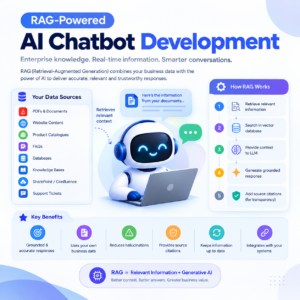
RAG-Powered AI Chatbot Development
One of the most important developments in modern conversational AI is Retrieval-Augmented Generation (RAG).
RAG allows a chatbot to retrieve relevant information from a business knowledge base before generating its response.
Your knowledge base could contain:
- Product catalogues
- PDFs
- Website content
- FAQs
- Company policies
- Technical documentation
- Training materials
- Support documentation
- Databases
The typical workflow is:
User Question → Information Retrieval → Relevant Context → AI Model → Grounded Response
This is particularly useful when businesses want an AI assistant to answer questions using their own information rather than relying only on the model’s general knowledge.
Current chatbot providers increasingly include RAG, knowledge retrieval and business-data integration as core capabilities.
Key Features of AI Chatbots
Effective ai chatbot development services can include a range of intelligent capabilities depending on the project’s requirements.
Natural Language Understanding
The chatbot can interpret different ways users express the same intent.
Context-Aware Conversations
The system can use previous messages to understand the current conversation instead of treating every question independently.
Multilingual Support
Businesses can develop conversational experiences for multiple languages, helping them serve customers across different regions.
Knowledge Base Integration
AI assistants can retrieve information from approved company documents and databases.
Lead Qualification
A chatbot can ask predefined questions, identify buying intent and send qualified prospects to sales teams.
Human Handoff
When a request is too complex or requires human intervention, the chatbot can transfer the conversation to an agent with relevant context.
Analytics
Businesses can monitor conversations, frequently asked questions, unresolved requests, conversions and escalation rates.
SoftTeco, for example, highlights multilingual support, contextual responses, security and multi-channel integration as important chatbot capabilities.
AI Chatbot Integrations
A chatbot becomes more valuable when it can interact with existing business systems.
CRM Integration
Possible applications include:
- Creating contacts
- Updating customer records
- Assigning leads
- Tracking conversations
- Scheduling follow-ups
ERP Integration
Chatbots can retrieve information from enterprise systems and assist employees with routine processes.
E-commerce Integration
An AI shopping assistant can help customers search products, understand specifications, compare options and receive order-related assistance.
Payment and Booking Integration
Where securely implemented, conversational systems can connect with payment gateways, calendars and booking platforms.
EffectiveSoft highlights integrations with websites, e-commerce platforms, social media, mobile applications, CRM, ERP and specialized business software.
AI Chatbot Development Process
Professional ai chatbot development services should follow a structured process.
1. Requirement Analysis
The development team identifies business objectives, users, use cases, data sources, integrations and success metrics.
2. Conversation Design
Conversation flows, intents, fallback scenarios and human escalation paths are designed.
3. Architecture Planning
The appropriate AI model, database, APIs, hosting environment, security controls and retrieval architecture are selected.
4. Knowledge Preparation
Business documents and other approved information are prepared for retrieval or other AI workflows.
5. Development
Developers build the conversational interface, AI logic, backend services and required integrations.
6. Testing
The chatbot is tested for response quality, security, edge cases, incorrect responses, integration failures and usability.
7. Deployment
The solution is deployed to the required website, application, WhatsApp channel or internal environment.
8. Monitoring and Optimization
Post-launch data is used to identify weak responses, user drop-offs and opportunities for improvement.
EffectiveSoft follows a similar lifecycle covering business analysis, architecture, UX, development, testing, deployment and continuous improvement.
Industries Using AI Chatbots
The applications of conversational AI extend across many industries.
E-commerce
- Product recommendations
- Customer support
- Order assistance
- Lead generation
Healthcare
- Appointment assistance
- General information
- Patient navigation
- Administrative support
Education
- Course enquiries
- Admission assistance
- Student support
- Frequently asked questions
Real Estate
- Property enquiries
- Lead qualification
- Property recommendations
- Appointment scheduling
Banking and Finance
- Customer support
- Product information
- Lead qualification
- Routine enquiries
SaaS and Technology
- Technical support
- Product onboarding
- Documentation assistance
- Troubleshooting
AI Chatbot Security and Data Privacy
Security should be considered from the beginning of chatbot development.
Important controls can include:
- Authentication
- Authorization
- Encryption
- Role-based access
- Secure APIs
- Data protection
- Audit logging
- Access-controlled knowledge retrieval
- AI guardrails
- Prompt-injection protection
- Human escalation
Enterprise chatbot architecture should also consider applicable privacy and industry-specific compliance requirements.
Appinventiv and EffectiveSoft both emphasize security, controlled data access and compliance considerations within their chatbot development approaches.
Benefits of AI Chatbot Development
The right chatbot implementation can provide several business benefits:
- 24/7 customer assistance
- Faster response times
- Reduced repetitive support workload
- Improved lead qualification
- Better customer engagement
- Personalized interactions
- Faster information retrieval
- Automated workflows
- Consistent responses
- Scalable customer support
However, successful implementation depends on the quality of the underlying data, integrations, conversation design, AI evaluation and ongoing monitoring.
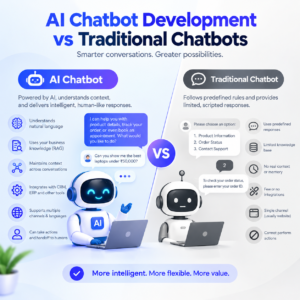
AI Chatbot Development vs Traditional Chatbots
Traditional chatbots generally rely on predefined rules and decision trees. They can be effective for predictable questions but may struggle with variations in language or complex conversations.
Modern AI chatbots can use LLMs, contextual understanding and knowledge retrieval to handle broader conversational scenarios.
The important distinction is not simply that one uses “AI” and another does not. The better question is whether the solution can reliably understand user intent, access the right information and complete the required business task.
Learn AI and Digital Marketing with Manjeet Madhukar’s through practical courses covering AI tools, SEO, social media marketing, and digital marketing strategies.
Conclusion
AI chatbot development services are evolving from simple customer-service widgets into intelligent business systems that can understand conversations, retrieve company information, connect with business applications and automate selected workflows.
The most effective solutions combine the right AI model with reliable business data, thoughtful conversation design, secure integrations and continuous monitoring. Custom ai chatbot development services are particularly valuable when a business has unique workflows, proprietary information or complex integration requirements.
Whether the goal is customer support, lead generation, sales automation, knowledge management or workflow automation, a properly designed AI chatbot can become an important part of a company’s digital strategy.
Frequently Asked Questions
1. What are AI chatbot development services?
They include the consulting, design, development, integration, testing, deployment and maintenance required to build an AI-powered conversational system for a business.
2. What are custom AI chatbot development services?
Custom ai chatbot development services involve creating a chatbot around a company’s specific workflows, data, users, integrations, security requirements and business objectives rather than deploying a generic solution.
3. How much does AI chatbot development cost?
The cost depends on factors such as chatbot complexity, AI model, number of channels, integrations, data volume, RAG requirements, security and expected usage. A simple FAQ bot can cost considerably less than an enterprise RAG or AI-agent system.
4. Can an AI chatbot use our company data?
Yes. A RAG-based implementation can retrieve information from approved company documents, websites, FAQs, product catalogues and other knowledge sources.
5. Can an AI chatbot integrate with a CRM?
Yes. With appropriate APIs and permissions, a chatbot can retrieve or update CRM information, create leads, record conversations and trigger workflows.
6. Can you develop an AI chatbot for WhatsApp?
Yes. A properly integrated WhatsApp chatbot can support customer enquiries, lead qualification, order assistance, appointments and other approved workflows.
7. Can AI chatbots support multiple languages?
Yes. Multilingual conversational systems can be designed for multiple languages, although each supported language should be tested for response quality and business terminology.
8. Can an AI chatbot transfer a conversation to a human?
Yes. Human handoff can be configured when the customer requests an agent, the chatbot cannot confidently resolve an issue or a particular workflow requires human involvement.
9. How long does chatbot development take?
The timeline depends on scope. A simple proof of concept can be developed much faster than a production enterprise system involving RAG, CRM, WhatsApp, security and multiple workflows. SoftTeco, for example, states that its PoCs may take 2–6 weeks while MVP development can take 2–4 months, with more complex projects requiring additional time.
10. Why choose custom chatbot development?
Custom development provides greater control over the chatbot’s functionality, business data, integrations, security, user experience and future scalability compared with a generic chatbot platform.