
Artificial intelligence is changing how companies manage everyday work. From customer support and sales follow-ups to document processing and data management, businesses are using intelligent systems to reduce repetitive work and improve operational efficiency. AI automation services combine artificial intelligence with workflows, APIs, business applications and automation platforms to turn manual processes into connected systems.
What Are AI Automation Services?
AI automation services are professional solutions that use AI technologies to understand information, make decisions and trigger actions within business workflows. Unlike simple rule-based automation, AI can work with natural language, documents, customer messages and other less-structured information. Modern implementations may combine generative AI, machine learning, AI agents, robotic process automation (RPA), APIs and integrations.
The goal is not simply to replace human workers. It is to remove repetitive administrative work so employees can focus on activities requiring creativity, judgment, relationships and strategy. Salesforce describes AI automation as a way to use AI to review data, recognize patterns and make logical choices, while Chetu connects intelligent automation with RPA, analytics, workflow management and enterprise integrations.
Why Do Businesses Need AI Automation?
Many organizations lose valuable time moving information between systems, responding to repetitive questions, updating spreadsheets, processing documents and following up with leads. As transaction volumes increase, manual processes can create delays, errors and higher operating costs.
AI automation services for businesses can address these problems by connecting existing tools and allowing information to move automatically. For example, a new website enquiry can be analyzed by AI, classified according to customer intent, entered into a CRM, followed by an automated WhatsApp or email response, and assigned to a salesperson.
This approach can help businesses respond faster, reduce manual data entry and create more consistent processes. Current providers increasingly measure success through time saved, reduced operational overhead, improved data quality, faster cycle times and ROI rather than technology adoption alone.
Key AI Automation Services
AI Workflow Automation
AI automation services can connect multiple steps into one process. A workflow might begin with a website form, email, WhatsApp message or uploaded document. AI can interpret the input and then trigger actions in CRM systems, databases, email platforms or internal applications.
For example:
Lead received → AI qualification → CRM update → personalized response → sales assignment → follow-up reminder
AI Agent Development
AI agents go beyond basic automation. An agent can be designed to understand a goal, retrieve information, use approved tools and complete multiple steps. This makes agents useful for sales qualification, customer service, research, internal assistance and operational tasks.
Good agentic systems should include permissions, validation, monitoring and human escalation for sensitive actions. Automaly, for example, describes custom AI agents as systems that can reason, adapt and act across connected business processes.
AI Chatbot and Customer Support Automation
AI chatbots can answer common questions, retrieve approved business information, qualify leads and route complex issues to employees. When connected with CRM systems and knowledge bases, they become more than basic website chat widgets.
A customer might ask about a product, receive an AI-generated response based on approved information, request a quotation and then be transferred to a salesperson without requiring separate manual data entry.
WhatsApp and Voice Automation
For businesses that communicate heavily through messaging and phone calls, AI can automate lead responses, appointment scheduling, reminders, customer enquiries and follow-ups. Voice agents can answer or place calls, collect information and update connected systems.
CRM and Sales Automation
AI can help sales teams capture, classify, score and route leads. It can also summarize conversations, prepare follow-ups, update pipeline records and identify opportunities that need human attention. Salesforce similarly highlights AI-powered sales workflows, customer data and automated sales processes as important business applications.
Marketing Automation
AI can support customer segmentation, lead nurturing, campaign workflows, content operations, reporting and personalized communication. The best approach connects these activities to measurable business goals rather than using AI simply to generate more content.
Document and Data Automation
Businesses often spend substantial time reviewing invoices, purchase orders, applications, contracts and reports. AI can extract information, classify documents, validate fields and send structured data to downstream systems.
A typical workflow could be:
Invoice received → information extracted → fields validated → accounting system updated → approval requested
Oracle identifies document understanding, NLP, LLMs and RAG as technologies that can extend automation beyond fixed rule-based processes.
AI Automation Across Business Functions
AI automation services can support multiple departments.
Sales teams can automate lead qualification and follow-ups. Marketing teams can automate segmentation and campaign workflows. Customer service teams can automate ticket classification and routine responses. Finance teams can automate document processing and reporting. HR teams can streamline candidate and employee workflows. Operations teams can automate approvals, data transfers and internal reporting.
This departmental approach is also reflected in current enterprise offerings that connect AI automation with sales, marketing, customer service, finance, operations and other business functions.
AI Automation for Different Industries
The use cases vary by industry.
In ecommerce, automation can support product recommendations, order communication, customer support and inventory workflows. In healthcare, it can help with scheduling, administrative documentation and communication, subject to appropriate professional oversight. In finance, automation can assist with document processing, fraud monitoring and customer service. Manufacturing businesses can use intelligent automation for production planning, quality processes, maintenance and supply-chain operations.
Brihaspati highlights applications across education, hospitality, retail, ecommerce, fintech, healthcare and legal services, while Chetu covers finance, healthcare, manufacturing, retail, logistics and professional services.
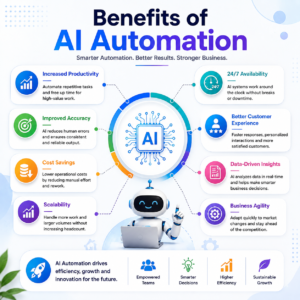
Benefits of AI Automation
The strongest business case comes from measurable outcomes.
First, AI automation services can reduce repetitive manual work and give employees more time for high-value activities. Second, connected workflows can reduce data-entry errors and delays. Third, faster responses can improve customer experience and sales follow-up. Fourth, automated reporting can make important information easier to access. Finally, scalable workflows can help businesses handle greater volumes without increasing every manual activity.
However, businesses should not automate a process simply because AI is available. A simple rule-based workflow may be cheaper, faster and more reliable when the task is predictable. AI is most valuable when the workflow requires interpretation, classification, language understanding or context.
AI Automation Tools and Technologies
Modern AI automation services may combine AI models with workflow and integration technologies. Depending on the use case, a solution may use OpenAI, Gemini or other large language models; n8n, Make, Zapier or Power Automate; CRM and ERP integrations; APIs and webhooks; databases; cloud platforms; or RAG systems that allow AI to retrieve information from business documents and knowledge bases.
Oracle explains that AI automation can combine LLMs, vector search and RAG with enterprise data, while Brihaspati highlights technologies including Python, vector databases, LangChain, LlamaIndex and cloud AI platforms.
Technology should follow the business requirement. A professional provider should first understand the workflow, data and desired outcome before selecting tools.
How AI Automation Is Implemented
A reliable implementation usually starts with an automation assessment. The business identifies repetitive processes, bottlenecks, risks and measurable objectives. The next step is workflow mapping and prioritization.
After that, the solution architecture is designed, integrations are configured and a pilot is tested. Once the workflow performs reliably, it can be deployed and monitored. Ongoing optimization is important because business processes, software and AI models can change over time.
This assessment-first approach is reflected in current providers such as Automaly, Chetu and Brihaspati, which emphasize business analysis, technology selection, integration, monitoring and continuous improvement.
Security and Human Oversight
Responsible AI automation services require more than technical integration. Systems should use appropriate access permissions, secure credentials, monitoring, logging and clear escalation rules. Sensitive processes may require human approval before an AI system can complete an action.
Businesses should also consider data privacy, model reliability, bias, error handling and auditability. Salesforce identifies data quality, privacy, legacy integration, bias and human oversight as important considerations when implementing AI automation.
How Much Do AI Automation Services Cost?
Pricing depends on complexity. A simple workflow connecting a few applications is very different from an enterprise system involving AI agents, voice, WhatsApp, CRM, ERP, databases, security and monitoring.
A useful evaluation should consider the number of workflows, integrations, AI usage, data volume, development requirements, security needs and ongoing support. Businesses should also compare expected savings or revenue improvement against implementation and maintenance costs. Oracle similarly notes that AI automation costs can include model expertise, infrastructure, databases and related technology requirements.
Learn AI and Digital Marketing with Manjeet Madhukar’s through practical courses covering AI tools, SEO, social media marketing, and digital marketing strategies.
Conclusion
AI automation services are becoming a practical way for organizations to improve how work moves through their businesses. The greatest value does not come from adding AI to every task. It comes from identifying the right processes and connecting AI with data, applications, workflows and human oversight.
For companies exploring AI automation services for businesses, the best strategy is to start with a measurable business problem, select technology according to the workflow and continuously monitor the results. When implemented correctly, AI automation can reduce repetitive work, improve response times, streamline operations and create scalable processes.
Frequently Asked Questions
What are AI automation services?
They are professional solutions that use artificial intelligence, automated workflows and software integrations to perform business tasks with less manual intervention.
How can AI automation services for businesses improve productivity?
They can automate repetitive activities such as data entry, lead follow-up, document processing, customer enquiries and reporting, allowing employees to focus on higher-value work.
What is the difference between AI automation and traditional automation?
Traditional automation mainly follows predefined rules. AI automation can also interpret language, documents and contextual information before taking an action.
Can small businesses use AI automation?
Yes. Businesses can start with focused workflows such as lead management, appointment scheduling, customer support, email processing or CRM updates and expand as measurable results are demonstrated. Oracle notes that cloud-based AI capabilities have made automation increasingly accessible to small and midsize businesses.
Are AI automation systems secure?
Security depends on implementation. Access controls, data protection, monitoring, logging, human approval and appropriate governance should be built into sensitive workflows.
How do I choose an AI automation provider?
Look for a provider that starts with process analysis, understands your existing technology, explains expected ROI, provides security and monitoring, and can support the system after deployment.