
Digital marketing has become an essential part of modern business growth. As consumers increasingly use search engines, social media, websites and mobile devices to discover products and services, businesses need a strong online presence to remain visible and competitive. In India, digital advertising accounted for 44% of the total advertising market in FY2025, reaching ₹49,000 crore, while the country had around 806 million internet users.
Understanding the benefits of digital marketing can help businesses choose the right channels, reach relevant audiences and make better marketing decisions. Digital marketing includes SEO, social media marketing, content marketing, email marketing, PPC advertising, influencer marketing and other online strategies.
What Is Digital Marketing?
Digital marketing is the promotion of products, services or brands through digital channels such as search engines, websites, social media, email, online advertising and mobile platforms.
Unlike many traditional marketing methods, digital campaigns can be measured, adjusted and targeted according to audience behavior. Adobe highlights global reach, cost efficiency, measurable results, targeting, engagement, flexibility, conversion opportunities and ROI among the major advantages of digital marketing.
The real value comes from connecting these channels with specific business objectives rather than using them randomly.
20 Benefits of Digital Marketing
1. Wider Audience Reach
One of the biggest benefits of digital marketing is the ability to reach customers beyond geographical boundaries. A local company can target customers in its city, while an e-commerce or service business can reach audiences throughout India or internationally.
2. Cost-Effective Marketing
Digital marketing can provide flexible options for different budgets. Businesses can begin with SEO, content and organic social media and gradually invest in paid advertising.
Paid campaigns can also use defined spending limits, making it easier to control marketing expenditure. Adobe notes that many digital channels offer relatively low entry costs compared with traditional advertising.
3. Precise Audience Targeting
Digital platforms allow businesses to target audiences based on factors such as location, interests, demographics, search behavior and previous interactions.
This helps businesses focus their resources on people who are more relevant to their products or services instead of communicating with an unnecessarily broad audience.
4. Measurable Results
Another important benefit is measurement. Businesses can monitor impressions, clicks, website traffic, engagement, leads, conversions and other performance indicators.
This makes it possible to understand which campaigns are contributing to business objectives and which require improvement.
5. Better ROI Optimization
Digital marketing does not automatically guarantee a high return on investment. Its advantage is that businesses can measure performance and optimize campaigns.
For example, if one advertising campaign generates more qualified leads than another at a similar cost, the business can investigate the difference and adjust its budget accordingly.
6. Increased Website Traffic
SEO, social media, content marketing, PPC and email campaigns can bring relevant visitors to a business website.
However, the goal should not simply be to generate more visitors. Businesses should focus on attracting qualified traffic that has a genuine interest in their products, services or information.
7. More Lead Generation
Digital channels provide several opportunities for generating leads. Businesses can use search engine optimization, Google Ads, landing pages, social media campaigns, downloadable resources, email marketing and online forms.
A well-planned strategy can move potential customers from discovering a business to submitting an enquiry or requesting more information.
8. Stronger Brand Awareness
Consistent visibility across search engines, social media, video platforms and websites can help customers recognize a brand.
Repeated exposure, useful content and consistent messaging can strengthen brand familiarity and make a business easier to remember when customers are ready to purchase.
9. Better Customer Engagement
Digital platforms make communication more interactive. Customers can comment on posts, send messages, leave reviews, respond to emails and ask questions.
Adobe also highlights increased engagement as an important advantage because digital channels create opportunities for businesses to communicate directly with customers and gather feedback.
10. Better Understanding of Customer Behavior
Analytics can reveal what customers search for, which pages they visit, which content they interact with and where they leave a website.
These insights can help businesses improve their content, website experience, products and campaigns.
11. Personalized Marketing
Businesses can create different messages for different customer groups.
For example, a new visitor may receive educational content, while an existing customer may receive a product recommendation or loyalty offer.
Audience segmentation and personalization can make marketing communication more relevant. Adobe also identifies customer data, segmentation and personalization as important parts of an effective digital strategy.
12. Real-Time Campaign Optimization
Digital campaigns can often be modified quickly.
Marketers can test different headlines, images, audiences, keywords, offers and landing pages. Performance data can then be used to improve future campaigns.
This creates a continuous process of testing, measuring and optimizing.
13. Local Business Visibility
Digital marketing is particularly useful for local businesses.
Local SEO, Google Business Profile optimization, reviews and location-specific content can help businesses become more visible when nearby customers search for relevant products or services.
For example, a customer searching for “printer dealer near me” may discover a local business through online search.
14. Global Market Expansion
Businesses can use digital channels to test demand in new cities, states or countries without immediately establishing a physical presence.
SEO, localized content, social media and paid campaigns can help companies reach international audiences and evaluate potential markets.
15. Customer Retention
Digital marketing isn’t only about acquiring new customers. Email campaigns, social media, remarketing, personalized communication and useful content can help businesses stay connected with existing customers.
Long-term engagement can support repeat purchases and customer loyalty.
16. Competitive Advantage
A strong online presence can help smaller businesses compete in specific markets.
Businesses can differentiate themselves through useful content, better customer experiences, positive reviews, strong SEO and targeted campaigns rather than trying to compete with larger companies on advertising budget alone.
17. Scalability
Digital campaigns can grow as a business grows.
A company might start with local SEO and social media, then introduce PPC advertising, email marketing, content marketing and automation as its customer base expands.
This makes digital marketing suitable for startups, small businesses and established organizations.
18. 24/7 Online Presence
A website, social media profile and online content can remain accessible outside normal business hours.
Customers can research products, read information, compare services or submit enquiries whenever they are ready.
This creates additional opportunities for businesses to interact with potential customers beyond traditional operating hours.
19. AI and Marketing Automation
AI and automation are becoming increasingly important in modern marketing. Businesses can use technology for content assistance, audience analysis, personalization, customer support, campaign optimization and marketing automation.
India’s digital advertising market is also being influenced by AI, automation, mobile usage and changing consumer behavior.
20. Supports Long-Term Business Growth
The most important of the benefits of digital marketing is that different channels can work together.
For example:
SEO → Website Traffic → Engagement → Lead → Conversion → Customer → Retention
Instead of treating SEO, social media, email and paid advertising as separate activities, businesses can build an integrated customer journey.
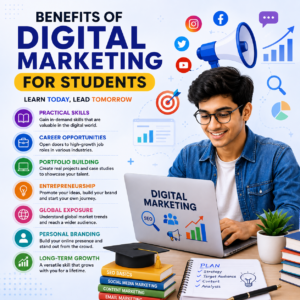
Benefits of Digital Marketing for Students
The benefits of digital marketing for students go beyond understanding advertising. Digital marketing can help students develop practical skills that are useful for internships, employment, freelancing and entrepreneurship.
1. Practical Skills
Students can learn SEO, content writing, social media management, analytics, advertising and email marketing through practical projects.
2. Career Opportunities
Digital marketing skills can support career paths such as SEO executive, social media manager, PPC specialist, content marketer, email marketer and digital marketing analyst.
3. Portfolio Development
Students can create blogs, social media campaigns, websites or sample advertising projects and use them as evidence of practical ability when applying for internships and jobs.
4. Freelancing Opportunities
Digital marketing skills can also be applied to freelance projects for small businesses, creators and online brands.
5. Personal Branding
Students can use digital platforms to develop professional profiles, publish useful content and demonstrate their knowledge to potential employers.
A recent student-focused career resource similarly highlights practical experience, portfolio development, internships, freelancing and personal branding as reasons students can benefit from learning digital marketing before graduation.
Digital Marketing vs Traditional Marketing
Factor |
Digital Marketing |
Traditional Marketing |
Audience targeting |
Highly targeted |
Generally broader |
Measurement |
Detailed analytics |
Often less precise |
Budget flexibility |
High |
Depends on medium |
Engagement |
Interactive |
Mostly one-way |
Optimization |
Can be frequent |
Usually more difficult |
Geographic reach |
Local to global |
Depends on channel |
Personalization |
Strong |
More limited |
This does not mean traditional marketing has no value. The right choice depends on the business, audience, objectives and available resources.
Why Digital Marketing Is Important in India
India’s digital ecosystem continues to expand. Ipsos reports that India added 56 million internet users in 2025, taking the country’s internet-user base to 806 million. Digital advertising reached ₹49,000 crore in FY2025 and is projected to grow to ₹56,400 crore in FY2026.
This growth creates opportunities for businesses to connect with consumers through search, social media, mobile platforms, content and online advertising.
For Indian businesses, this makes digital marketing particularly valuable for building visibility, generating enquiries, reaching local customers and expanding into new markets.
If you want to build practical digital marketing skills, you can learn from Manjeet Madhukar, who provides professional digital marketing training along with real-world digital marketing services. His guidance can help you understand SEO, social media marketing, paid advertising and other essential skills while gaining practical industry knowledge.
Frequently Asked Questions
What are the main benefits of digital marketing?
The main benefits include wider reach, precise targeting, measurable results, flexible budgets, lead generation, brand awareness, customer engagement, personalization and opportunities to optimize campaigns.
Is digital marketing suitable for small businesses?
Yes. Small businesses can start with channels such as local SEO, social media, content marketing and email marketing and gradually add paid campaigns as their business grows.
What are the benefits of digital marketing for students?
The benefits of digital marketing for students include practical career skills, portfolio development, internship opportunities, freelancing possibilities, personal branding and better understanding of modern business communication.
Does digital marketing increase sales?
Digital marketing can contribute to sales by increasing visibility, attracting relevant traffic, generating leads and supporting customer conversion. Results depend on strategy, audience, competition, budget and execution.
Is digital marketing better than traditional marketing?
Neither is universally better. Digital marketing provides strong targeting, measurement and flexibility, while traditional channels can still be useful for broad awareness and specific audiences.
How long does digital marketing take to show results?
The timeline depends on the channel. Paid advertising can generate traffic quickly, while SEO and content marketing generally require consistent effort and time to build sustainable organic visibility.
Conclusion
The benefits of digital marketing extend far beyond simply promoting a business online. Digital channels allow businesses to reach relevant audiences, understand customer behavior, measure performance, generate leads, build relationships and optimize marketing investments.
For students, the benefits of digital marketing for students include practical skills, portfolio development, career opportunities, freelancing and personal branding.
With India’s internet audience continuing to expand and digital advertising representing a significant share of the country’s advertising market, having a well-planned digital presence is becoming increasingly important for businesses.
The key is not to use every digital channel. Businesses should select the channels that match their audience, goals, budget and customer journey, measure meaningful KPIs and continuously improve their strategy.