
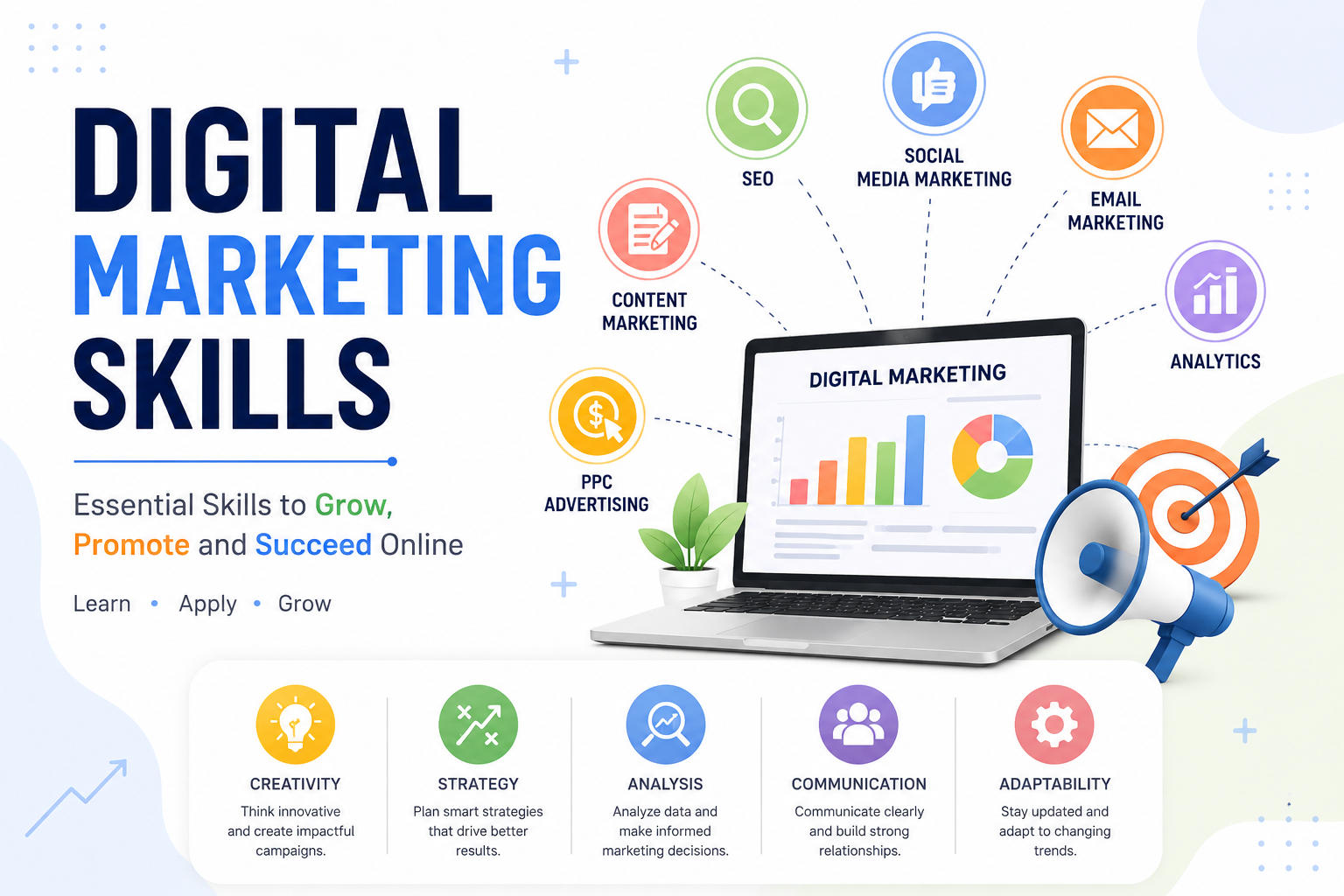
Digital marketing has become an essential part of how businesses attract customers, build brand awareness, generate leads, and increase sales. As businesses increasingly depend on websites, search engines, social media, email, paid advertising, and data, marketers need a combination of technical, creative, analytical, and strategic abilities.
The right digital marketing skills can help beginners start a career, professionals improve their expertise, and businesses create more effective online campaigns. Modern marketing is also becoming more integrated, with SEO, content, social media, advertising, email, and analytics working together rather than operating as separate activities. FutureLearn’s Accenture-backed course similarly emphasizes choosing and integrating different digital marketing techniques according to business and customer needs.
Whether you are a student, fresher, freelancer, entrepreneur, or marketing professional, understanding the following skills can help you build a stronger digital marketing foundation.
What Are Digital Marketing Skills?
Digital marketing skills are the abilities required to plan, execute, manage, measure, and improve marketing activities across digital channels.
These abilities can include:
- Search engine optimization
- Search engine marketing
- Content marketing
- Social media marketing
- Email marketing
- Copywriting
- Data analytics
- Conversion optimization
- Marketing automation
- Customer research
- Digital strategy
- AI-assisted marketing
The most effective marketers do not simply know how to operate individual platforms. They understand the customer, select appropriate channels, create relevant messages, measure results, and continuously optimize their campaigns.
HubSpot’s digital marketing certification follows a similar approach by combining strategy, content marketing, email, lead generation, SEO, social media, inbound marketing, and reporting.
15 Essential Digital Marketing Skills to Learn
1. Search Engine Optimization (SEO)
SEO is one of the most important digital marketing skills because it helps businesses improve their visibility in organic search results.
A marketer should understand:
- Keyword research
- Search intent
- On-page SEO
- Technical SEO
- Internal linking
- Content optimization
- Local SEO
- Off-page SEO
- Search performance analysis
SEO is not simply about adding keywords to a page. It involves creating useful content, improving website structure, understanding users, and helping search engines discover and understand a website.
Current career-focused resources continue to identify SEO as a fundamental capability for digital marketers.
2. Keyword Research and Search Intent
Keyword research helps marketers understand what potential customers are searching for online.
A skilled marketer should be able to identify:
- Short-tail keywords
- Long-tail keywords
- Informational queries
- Commercial keywords
- Transactional keywords
- Local searches
- Question-based searches
Search intent is equally important. A marketer must understand whether someone wants information, is comparing products, or is ready to make a purchase.
This skill helps businesses create the right content for the right audience at the right stage of the buying journey.
3. Content Marketing
Content marketing involves creating and distributing useful information to attract and engage a target audience.
Content can include:
- Blog posts
- Guides
- Videos
- Infographics
- Social media posts
- Ebooks
- Case studies
- Newsletters
- Web content
A successful content marketer combines audience research, SEO, storytelling, and distribution. Internshala identifies content creation and content marketing among the important capabilities marketers should develop.
4. Copywriting
Copywriting focuses on persuasive marketing communication.
Marketers use copywriting for:
- Advertisements
- Landing pages
- Product descriptions
- Emails
- Social media captions
- Headlines
- Calls to action
Effective copy clearly communicates a problem, presents a benefit, builds interest, and encourages the reader to take action.
Strong writing and editing abilities are therefore important skills needed for digital marketing, especially for content, advertising, email, and conversion-focused roles.
5. Social Media Marketing
Social media provides businesses with opportunities to reach, engage, and build relationships with customers.
Important areas include:
- Content planning
- Audience research
- Community management
- Social media strategy
- Short-form video
- Organic engagement
- Social analytics
- Paid social advertising
A marketer should understand that different platforms require different content approaches. The objective is not simply to post frequently but to create content that supports awareness, engagement, traffic, leads, or sales.
HubSpot’s current training also covers organic and paid social strategies, audience selection, content development, community building, and advertising.
6. Pay-Per-Click (PPC) and Search Engine Marketing
PPC allows businesses to reach potential customers through paid advertising.
Important PPC abilities include:
- Keyword targeting
- Campaign setup
- Ad copy
- Audience targeting
- Budget management
- Bidding
- Landing pages
- Conversion tracking
- Performance analysis
Google Ads and other advertising platforms require marketers to understand both creative messaging and data.
Internshala also highlights SEM, PPC, bidding, ad formats, landing pages, and conversion tracking as important capabilities for search marketing.
7. Data Analytics
Data analytics is among the most valuable digital marketing skills because it helps marketers understand whether campaigns are producing meaningful results.
Marketers should learn how to analyze:
- Website traffic
- Engagement
- Leads
- Conversion rates
- Campaign performance
- Customer behavior
- Cost per acquisition
- Return on advertising spend
Tools such as Google Analytics, Google Search Console, advertising dashboards, and reporting platforms can help collect and interpret marketing data.
The important ability is not simply reading numbers. It is turning data into insights and using those insights to make better decisions. Internshala specifically emphasizes analyzing trends and converting data into actionable steps.
8. Email Marketing
Email marketing helps businesses communicate directly with prospects and customers.
Important skills include:
- Email copywriting
- Audience segmentation
- Personalization
- Campaign planning
- Automation
- A/B testing
- Performance measurement
Email can support lead nurturing, promotions, customer retention, and repeat purchases.
HubSpot’s curriculum treats email as an important channel that can also support other marketing activities such as content, SEO, and social media.
9. Conversion Rate Optimization (CRO)
Driving traffic is only one part of digital marketing. Businesses also need to convert visitors into leads or customers.
CRO focuses on improving:
- Landing pages
- Forms
- Headlines
- CTAs
- User experience
- Page layouts
- Checkout processes
A marketer can use analytics and A/B testing to identify problems and test improvements.
This makes CRO an important bridge between marketing traffic and business results.
10. Marketing Strategy
Strategy is one of the most important skills needed for digital marketing because it connects individual activities with business objectives.
A marketer should be able to define:
- Business objectives
- Target audience
- Customer needs
- Marketing channels
- Content strategy
- Budget
- KPIs
- Measurement methods
FutureLearn emphasizes selecting appropriate channels based on audience, goals, and campaign requirements, while its course also highlights the importance of integrating different marketing techniques.
11. Customer and Competitor Research
Successful marketing starts with understanding people.
Customer research helps marketers identify:
- Customer problems
- Needs
- Preferences
- Search behavior
- Objections
- Purchase motivations
Competitor research can reveal:
- Content opportunities
- Keywords
- Advertising approaches
- Offers
- Positioning
- Customer complaints
Together, these abilities help marketers develop more relevant strategies.
12. Marketing Automation and CRM
Automation helps marketers manage repetitive activities efficiently.
Examples include:
- Automated emails
- Lead nurturing
- Customer segmentation
- CRM workflows
- Campaign notifications
- Reporting
CRM knowledge is particularly useful for businesses that need to manage leads and customer relationships throughout the buying journey.
Internshala includes CRM and conversion optimization in its current list of important marketing capabilities.
13. Visual and Video Content Creation
Visual content is increasingly important across websites and social platforms.
Marketers can benefit from basic knowledge of:
- Graphic design
- Typography
- Branding
- Image editing
- Video scripting
- Short-form video
- Thumbnails
A marketer does not always need to become a professional designer or video editor. However, understanding visual communication can improve social posts, advertisements, landing pages, and content campaigns.
14. AI-Powered Marketing
AI is becoming an important addition to modern marketing workflows.
Marketers can use AI for:
- Content ideation
- Research
- Copy variations
- Audience analysis
- Data interpretation
- Personalization
- Workflow automation
- Campaign brainstorming
However, AI should support human judgment rather than replace it. Marketers still need to verify information, understand customers, protect brand voice, and make strategic decisions.
HubSpot’s current certification includes a dedicated lesson on AI as a strategic advantage in digital marketing, focusing on efficiency, personalization, insights, and performance.
15. Communication and Problem-Solving
Technical knowledge alone does not make someone a successful marketer.
Strong communication helps marketers work with:
- Customers
- Clients
- Designers
- Developers
- Sales teams
- Business owners
Problem-solving is equally important because campaigns rarely perform perfectly on the first attempt.
A good marketer can identify what is not working, analyze the reason, test alternatives, and improve performance.
Internshala also places communication and creative thinking at the beginning of its list of important marketing capabilities.
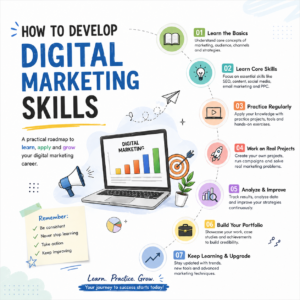
How to Develop Digital Marketing Skills
The best way to develop these abilities is through a combination of learning and practical experience.
Step 1: Learn the fundamentals
Understand marketing concepts, customer journeys, audiences, funnels, and business objectives.
Step 2: Learn core channels
Start with SEO, content, social media, PPC, and email marketing.
Step 3: Learn analytics
Understand how to measure traffic, engagement, leads, conversions, and campaign performance.
Step 4: Practice with real projects
Create a website, manage a social media page, conduct keyword research, or build a sample advertising campaign.
Step 5: Build a portfolio
Document your work and show the strategy, execution, and results.
Step 6: Keep learning
Digital marketing changes quickly. Continue learning about AI, automation, search changes, analytics, and new platforms.
FutureLearn’s digital marketing curriculum similarly combines learning with practical activities and emphasizes designing, executing, and optimizing campaigns.
If you want to build practical digital marketing skills, you can learn from Manjeet Madhukar, who provides professional digital marketing training along with real-world digital marketing services. His guidance can help you understand SEO, social media marketing, paid advertising and other essential skills while gaining practical industry knowledge.
Digital Marketing Skills for Freshers
Freshers do not need to master every marketing channel before applying for a job.
A practical starting combination is:
SEO + Content + Social Media + Analytics + PPC fundamentals
After building a foundation, you can specialize in areas such as SEO, performance marketing, social media, content marketing, email marketing, analytics, or marketing automation.
For entry-level candidates, practical projects can be particularly valuable because they demonstrate that you can apply what you have learned.
Conclusion
Building strong digital marketing skills requires more than learning a few online tools. Successful marketers combine SEO, content, social media, PPC, email, analytics, conversion optimization, strategy, communication, and emerging technologies such as AI.
The most valuable approach is to understand how these skills work together. SEO can attract visitors, content can educate them, social media can expand reach, email can nurture prospects, paid advertising can generate targeted traffic, and analytics can show what is working.
As digital channels continue to evolve, marketers who combine technical knowledge with creativity, analytical thinking, adaptability, and customer understanding will be better prepared for changing opportunities. Whether you are a beginner, student, freelancer, or experienced professional, developing the right skills needed for digital marketing can help you create better campaigns and build a stronger career.
FAQs About Digital Marketing Skills
1. What are the most important digital marketing skills?
The most important areas include SEO, keyword research, content marketing, copywriting, social media marketing, PPC, analytics, email marketing, CRO, marketing strategy, AI, and communication.
2. What skills are needed for digital marketing as a fresher?
Freshers should begin with SEO, content creation, social media, basic analytics, PPC fundamentals, communication, and copywriting. Practical projects can help demonstrate these abilities.
3. Is SEO an important digital marketing skill?
Yes. SEO helps businesses improve organic visibility and attract relevant visitors from search engines. It also connects closely with content marketing, website optimization, and analytics.
4. Is coding required for digital marketing?
No. Most entry-level marketing roles do not require advanced coding. However, basic knowledge of HTML, website structure, tracking, or technical SEO can be helpful for certain roles.
5. Is AI a digital marketing skill?
AI is increasingly becoming part of modern marketing workflows. Marketers can use AI for research, content ideation, personalization, analysis, and automation while retaining human oversight and strategic decision-making.
6. How can I learn digital marketing skills?
Start with marketing fundamentals, then learn SEO, content, social media, PPC, email, and analytics. Practice through real projects and create a portfolio to demonstrate your abilities.