
SEO is one of the most important ways to improve a website’s visibility in organic search results. But SEO is not limited to adding keywords to a page or building backlinks. A successful SEO strategy combines different optimization activities that help search engines understand your website, evaluate its relevance, and recognize its authority.
The difference between on page and off page seo is mainly based on where optimization happens. On-page SEO focuses on elements you can control directly on your website, such as content, headings, title tags, URLs, internal links, and images. Off-page SEO focuses on activities outside your website, such as earning backlinks, building brand mentions, digital PR, and developing online authority.
Both approaches are important, but they serve different purposes. Understanding on page and off page seo can help beginners and marketers create a more complete SEO strategy. Semrush describes on-page SEO as optimization performed on webpages, while off-page SEO focuses on activities outside the website that help build trust and authority.
What Is On-Page SEO?
On-page SEO, also called on-site SEO, is the process of optimizing individual webpages to make them more useful to visitors and easier for search engines to understand.
The difference between on page and off page seo becomes clear when you look at control. With on-page SEO, you can directly change most of the elements involved. You can edit your content, improve your headings, update your title, add internal links, optimize images, and improve the structure of your pages.
According to Ahrefs, on-page SEO includes optimization of visible page content and HTML elements.
Important On-Page SEO Factors
1. High-Quality Content
Content is one of the most important parts of on-page optimization. Your content should answer the user’s search intent clearly and provide useful information.
Instead of writing an article only to include keywords, focus on:
- Answering the main question
- Providing original information
- Using clear examples
- Covering related questions
- Making the content easy to read
- Demonstrating relevant expertise
Google recommends creating helpful, reliable, people-first content instead of content created primarily to manipulate search rankings.
2. Keyword Optimization
Keywords help search engines understand the subject of a page. Your primary keyword can be included naturally in important locations such as:
- SEO title
- H1 heading
- Introduction
- Relevant H2/H3 headings
- URL where appropriate
- Body content
- Image alt text when genuinely relevant
However, keyword stuffing should be avoided. The goal is not to repeat the same phrase unnecessarily. Google’s guidance emphasizes useful content rather than writing primarily for search engines.
3. Title Tag
The title tag helps communicate the main topic of a webpage. A good title should be:
- Relevant
- Clear
- Concise
- Unique
- Written for the searcher
For example:
Poor title:
SEO | SEO | SEO | SEO
Better title:
Difference Between On Page and Off Page SEO: Complete Guide
4. Meta Description
A meta description summarizes a page and can help searchers understand what they will find after clicking the result.
A good meta description should:
- Describe the page accurately
- Include the main topic naturally
- Encourage a click
- Match the actual content
Remember that Google may generate the search-result snippet from the page content instead of using the exact meta description you provide.
5. Headings
A clear heading structure makes long content easier to scan.
For example:
- H1: Main topic
- H2: Major sections
- H3: Supporting sections
For this article, the H1 explains the main topic, while H2 headings separate on-page SEO, off-page SEO, their differences, techniques, and FAQs.
6. Internal Linking
Internal links connect one page of your website to another page on the same website.
For example, a digital marketing website could link from an article about on-page SEO to another article about:
- Keyword research
- Technical SEO
- SEO tools
- Content marketing
- Google Search Console
Internal linking helps users discover related content and helps search engines understand relationships between pages.
7. Image Optimization
Images can improve the user experience, but they should also be optimized.
Important practices include:
- Compressing images
- Using descriptive filenames
- Adding useful alt text
- Using appropriate image dimensions
- Avoiding unnecessarily large files
Alt text should describe the image rather than being used as a place to insert keywords repeatedly.
8. User Experience and Page Structure
A well-organized website makes it easier for users to find information.
Navigation, mobile usability, readable content, page performance, and logical site structure all contribute to a better overall experience.
GeeksforGeeks also identifies content quality, keyword optimization, meta tags, URLs, internal linking, UX, crawlability, indexing, canonicalization, and structured data among important on-page considerations.
What Is Off-Page SEO?
Off-page SEO refers to activities performed outside your own website that can help build its reputation, authority, visibility, and relationships across the web.
This is another important part of the difference between on page and off page seo.
Unlike on-page optimization, you have less direct control over off-page signals. For example, you can publish a useful article, but you cannot force another reputable website to link to it.
Ahrefs describes off-page SEO as focusing on SEO factors outside the page, while Semrush explains it as activities that improve a website’s reputation and authority.
Important Off-Page SEO Techniques
1. Earning Backlinks
A backlink is a link from another website to your website.
For example, suppose you publish original research about digital marketing statistics. A respected marketing publication references your research and links to your article. That is an external backlink.
However, more backlinks do not automatically mean better rankings. Relevance, context, quality, and natural acquisition matter.
Google continues to use link analysis and PageRank as part of its ranking systems, while also using many other systems and signals.
2. Digital PR
Digital PR involves creating stories, research, data, expert commentary, or resources that online publications may want to reference.
For example:
Topic:
“2026 Digital Marketing Trends for Small Businesses”
If your research contains original statistics, journalists and industry websites may reference it.
This can generate:
- Brand visibility
- Referral traffic
- Mentions
- Potential editorial links
3. Brand Mentions
A brand mention happens when another website, publication, social platform, or online source talks about your business or website.
Some mentions may include links, while others may not.
Building a recognizable and trustworthy brand can support your overall online presence.
4. Guest Contributions
Writing genuinely useful content for relevant external websites can help you reach a new audience and potentially earn appropriate references.
The important point is quality.
Publishing low-quality articles across hundreds of unrelated websites simply to obtain backlinks is not a sustainable SEO strategy.
5. Online Reputation
Reviews, public discussions, industry mentions, and customer experiences can contribute to how people perceive a business online.
For local businesses, reputation management can be particularly important.
6. Content Promotion
Creating great content is only one part of content marketing. Promoting useful resources through appropriate channels can help them reach people who may reference, share, or link to them.
GeeksforGeeks also lists backlinks, social media marketing, reputation management, influencer marketing, brand mentions, and guest blogging among off-page activities.
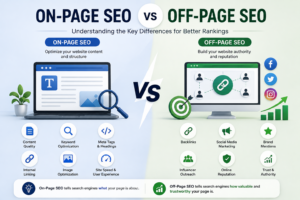
Difference Between On Page and Off Page SEO
The simplest difference between on page and off page seo is that on-page SEO happens on your website, while off-page SEO involves activities outside your website.
Factor |
On-Page SEO |
Off-Page SEO |
Location |
On your website |
Outside your website |
Main focus |
Content and page optimization |
Authority and reputation |
Control |
Mostly direct |
Mostly indirect |
Main activities |
Content, titles, headings, internal links |
Backlinks, PR, mentions |
Primary goal |
Improve relevance and usability |
Build external credibility |
Example |
Optimizing an H1 |
Earning an editorial backlink |
Time to implement |
Often faster |
Usually longer-term |
Main challenge |
Creating useful pages |
Earning genuine recognition |
Common tools |
Search Console, analytics, crawlers |
Backlink and reputation tools |
Main outcome |
Better page understanding |
Stronger external presence |
The difference between on page and off page seo is therefore not simply “inside versus outside.” It is also about control versus influence.
You control your title, content, headings, URL, and internal links. You can influence whether external websites, publishers, creators, or customers mention your business, but you cannot directly control those decisions.
On-Page SEO vs Off-Page SEO: Which Is More Important?
One of the most common SEO questions is whether on-page or off-page SEO is more important.
The best answer is that both are important, but they solve different problems.
On-page SEO provides the foundation. Your website needs useful content, logical structure, relevant information, and good usability before external promotion can reach its full potential.
Off-page SEO helps build recognition and authority beyond your own website.
Think of it this way:
On-page SEO = Build a strong website.
Off-page SEO = Build recognition for that website.
Semrush recommends strengthening on-site optimization first and then developing off-site authority over time.
Should You Do On-Page or Off-Page SEO First?
For most websites, start with on-page optimization.
A practical workflow is:
Step 1: Research the Keyword
Understand:
- Search intent
- Main keyword
- Related queries
- Competitor content
- Questions users ask
Step 2: Create Useful Content
Write content that genuinely answers the searcher’s question.
Step 3: Optimize the Page
Improve:
- Title
- H1
- Headings
- URL
- Meta description
- Internal links
- Images
- Content structure
Step 4: Check Technical Accessibility
Make sure search engines can crawl and index the page properly.
Step 5: Publish and Promote
Once the page is strong, promote it through relevant channels.
Step 6: Build External Authority
Work toward genuine mentions, relationships, citations, PR opportunities, and editorial backlinks.
This approach demonstrates how on page and off page seo can work together rather than treating them as competing strategies.
How On Page and Off Page SEO Work Together
Imagine you publish an article titled:
“Best AI Tools for Social Media in 2026”
On-page work
You:
- Research search intent
- Create useful comparisons
- Optimize the title
- Use descriptive headings
- Add internal links
- Optimize images
- Provide original insights
- Improve readability
Off-page work
You then:
- Promote the article
- Contact relevant publications
- Share original research
- Build relationships with industry websites
- Earn relevant editorial mentions
- Encourage genuine references
The result is a complete SEO strategy.
This is why the difference between on page and off page seo should not be interpreted as choosing one and ignoring the other.
Common On-Page SEO Mistakes
Avoid these mistakes:
Keyword Stuffing
Repeating a keyword unnaturally can make content difficult to read.
Weak Search Intent
A page may target the right keyword but still fail to answer what the user actually wants.
Poor Internal Linking
Important pages should not be isolated from the rest of your website.
Duplicate or Thin Content
Publishing pages with little original value can make it difficult to establish a strong content resource.
Ignoring User Experience
A page should be easy to read, navigate, and use on different devices.
Google’s people-first guidance recommends creating content primarily to help users rather than creating content primarily to attract search-engine traffic.
Common Off-Page SEO Mistakes
The most common mistakes include:
- Buying manipulative backlinks
- Building irrelevant links
- Using automated backlink software
- Mass directory submissions
- Spam comments
- Low-quality guest posting
- Excessive exact-match anchor text
- Focusing only on backlink quantity
Google’s systems specifically address link spam and manipulative link practices, so off-page SEO should focus on earning genuine recognition rather than trying to manipulate rankings.
On Page and Off Page SEO Checklist
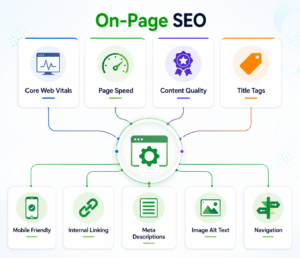
On-Page SEO Checklist
- Research search intent
- Choose the primary keyword
- Create helpful content
- Optimize the SEO title
- Write a useful meta description
- Use a clear H1
- Organize H2 and H3 headings
- Optimize the URL
- Add relevant internal links
- Optimize images
- Add descriptive alt text
- Improve mobile usability
- Check page performance
- Review indexing and crawlability
Off-Page SEO Checklist
- Create link-worthy content
- Promote original research
- Build relevant industry relationships
- Pursue digital PR opportunities
- Earn relevant backlinks
- Monitor brand mentions
- Maintain online reputation
- Contribute useful content to relevant websites
- Avoid manipulative link schemes
- Monitor referring domains and backlink quality
Is On Page and Off Page SEO Still Important in 2026?
Yes. However, modern SEO should not be reduced to keywords and backlinks.
Google’s current documentation describes multiple ranking systems and signals, including systems related to content usefulness, link analysis, spam detection, and understanding queries and content.
That means a modern SEO strategy should focus on:
Helpful content + strong page optimization + technical accessibility + good user experience + relevant external authority.
The difference between on page and off page seo is useful for understanding SEO strategy, but these categories should work together as part of a larger process.
FAQs About On Page and Off Page SEO
1. What is the difference between on page and off page SEO?
The main difference between on page and off page seo is where optimization takes place. On-page SEO involves improving elements on your own website, such as content, titles, headings, URLs, and internal links. Off-page SEO involves external activities such as earning backlinks, building brand mentions, and developing online authority.
2. What is on-page SEO?
On-page SEO is the process of optimizing individual webpages to improve their relevance, usability, structure, and search visibility. It includes content, keywords, headings, titles, URLs, internal links, images, and other page-level elements.
3. What is off-page SEO?
Off-page SEO involves activities outside your website that can help improve its reputation, authority, visibility, and relationships across the web. Backlinks, digital PR, brand mentions, and relevant external promotion are common examples.
4. Is backlink building on-page or off-page SEO?
Earning backlinks from other websites is an off-page SEO activity. Internal links between pages on your own website are generally considered an on-page or on-site optimization activity.
5. Which is more important: on-page or off-page SEO?
Neither should be considered a replacement for the other. On-page SEO helps create a strong, relevant website, while off-page SEO can help build external credibility and authority. A balanced strategy uses both.
6. Can a website rank without backlinks?
Yes, depending on the query, competition, website, and other factors. Backlinks can be valuable, but rankings are not determined by backlinks alone. Google uses multiple ranking systems and signals.
7. How long does off-page SEO take?
Off-page SEO is usually a long-term process. The time required depends on competition, industry, website authority, content quality, relationships, and the type of external promotion being used.
8. Should beginners start with on-page or off-page SEO?
Beginners should generally start by creating a technically accessible website with useful content and solid on-page optimization. Once the foundation is strong, they can develop sustainable off-page strategies.
Conclusion
Understanding the difference between on page and off page seo is essential for building a successful search optimization strategy.
On-page SEO focuses on what you can improve directly on your website: content, keywords, titles, headings, URLs, internal links, images, structure, and user experience. Off-page SEO focuses on what happens beyond your website, including backlinks, digital PR, brand mentions, relationships, and online reputation.
The best approach is not to choose between them. Instead, use on page and off page seo together.
Start by building a useful and well-optimized website. Make sure your pages satisfy search intent and provide genuine value. Then promote your best content and work toward earning relevant external recognition.
Ready to take your SEO skills to the next level? Learn from Manjeet Madhukar’s and discover practical SEO strategies you can apply to real projects.