

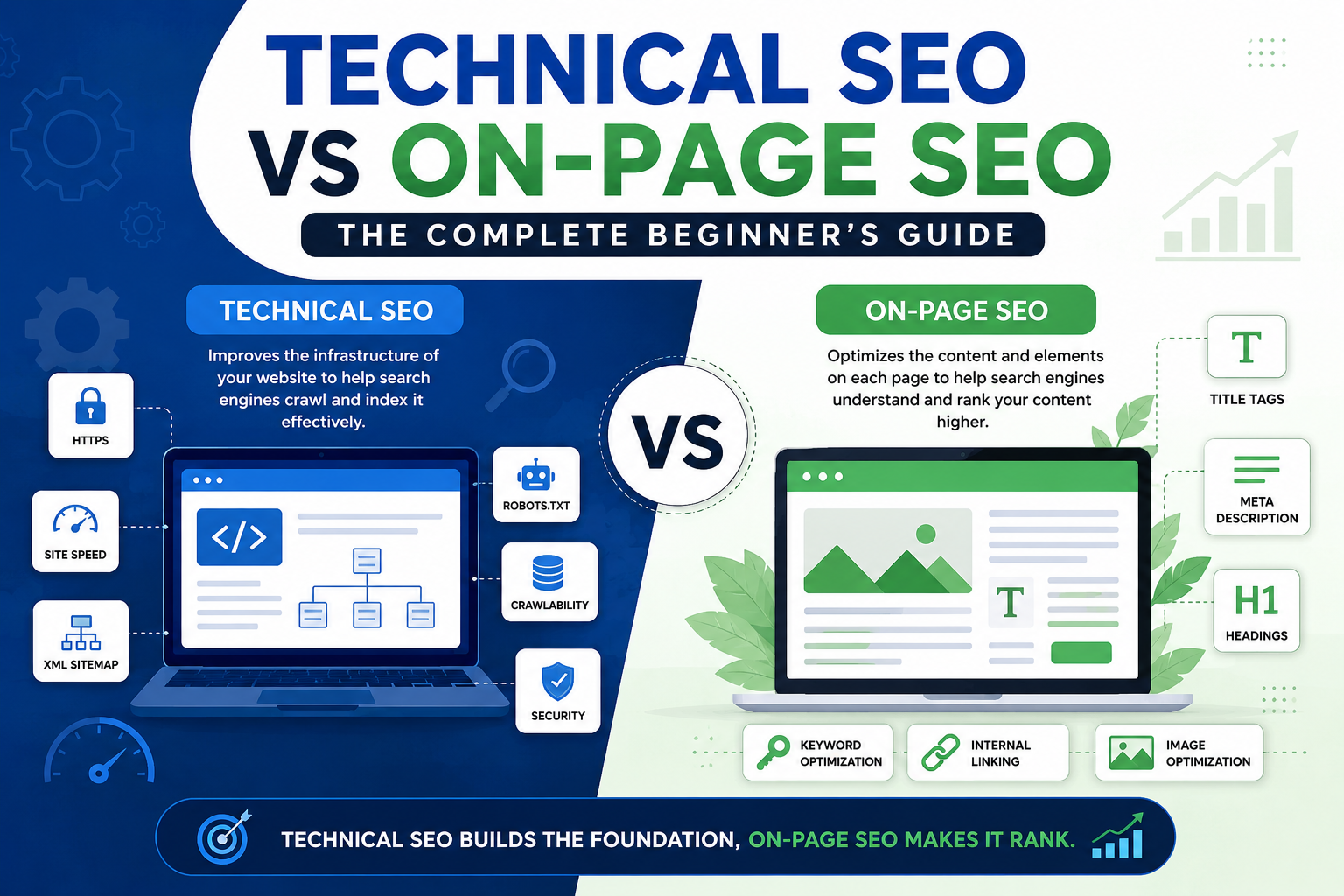
Anyone trying to rank higher on Google eventually runs into the same question: technical SEO vs on-page SEO — what’s the difference, and which one actually matters more? Both terms get used constantly in marketing circles, yet most explanations stop at vague definitions instead of showing you how to act on them.
This article is built as a practical Technical SEO guide and On-page SEO guide in one place. You’ll learn exactly what each discipline covers, how technical SEO vs on-page SEO compare side by side, which tools to use for each, and how to figure out which one your website needs right now.
Why the Technical SEO vs On-Page SEO Question Matters
Before diving into definitions, it’s worth understanding why the technical seo vs on page seo comparison trips up so many site owners. SEO is often marketed as a single service, but it’s really a collection of different skill sets bundled under one label. Someone excellent at writing keyword-optimized content may know almost nothing about server configuration or crawl budgets — and someone who can audit a site’s technical health may have never written a page of content in their life.
That’s exactly why the technical SEO vs on-page SEO distinction exists: it separates two genuinely different disciplines so you can diagnose problems accurately instead of guessing. Without this framework, it’s easy to waste months rewriting content when the real issue is that your pages aren’t indexed — or, just as often, obsessing over site speed when your actual problem is thin, unhelpful content.
What Is Technical SEO?
Technical SEO refers to everything that happens behind the scenes of your website that helps search engines crawl, render, and index your pages correctly. It has nothing to do with keywords or writing — it’s entirely about infrastructure. Grasping this distinction is the first step in any technical seo vs on page seo comparison.
Every reliable Technical SEO guide starts from the same premise: none of your content matters if search engines can’t access it. A slow, broken, or unindexed website will never rank, no matter how good the writing is. This is exactly why the technical seo vs on page seo conversation usually starts with technical SEO — it’s the foundation everything else depends on.
A solid Technical SEO guide typically covers:
- Crawlability and indexing — robots.txt configuration, XML sitemaps, and internal linking that guides bots through your site
- Site speed and Core Web Vitals — including Largest Contentful Paint (LCP) and Interaction to Next Paint (INP)
- Mobile-friendliness — since Google evaluates the mobile version of your site first
- HTTPS and security — encrypted, trustworthy connections
- Structured data (schema markup) — helping search engines understand and display your content
- Fixing broken links, redirects, and duplicate content that waste crawl budget
- Site architecture — a logical folder structure and URL hierarchy that makes navigation intuitive for both users and crawlers
What Is On-Page SEO?
If technical SEO is about access, on-page SEO is about relevance. On-page SEO covers the content and HTML elements that live directly on a page — the parts users actually read and interact with. This is the second half of the technical seo vs on page seo equation, and it’s where most content marketers spend the majority of their time.
A good On-page SEO guide focuses on aligning your content with what a searcher actually wants, while also giving search engines clear signals about the page’s topic. This is where the technical seo vs on page seo comparison shifts from “can search engines find this?” to “does this content deserve to rank?”
Core elements of any On-page SEO guide include the following, and most successful On-page SEO guide resources rank them roughly in this order of impact:
- Keyword usage — placing relevant terms naturally in titles, headers, and body copy
- Title tags and meta descriptions — your first impression in search results
- Header structure (H1, H2, H3) — organizes content for both readers and crawlers
- Content quality and depth — original, thorough answers to the searcher’s question
- Internal linking — connecting related pages to distribute authority
- Image optimization — descriptive alt text and compressed file sizes
- Readability — short paragraphs, plain language, and logical flow that keeps visitors engaged

Technical SEO vs On-Page SEO: Key Differences
The clearest way to understand technical SEO vs on-page SEO is through a simple analogy: technical SEO opens the door, and on-page SEO gives visitors a reason to stay.
Factor |
Technical SEO |
On-Page SEO |
Focus |
Site infrastructure and backend |
Content and visible page elements |
Who sees it |
Search engine crawlers |
Users and search engines |
Goal |
Crawlable, fast, indexable site |
Relevant, engaging content |
Frequency |
Mostly one-time, then maintained |
Ongoing and iterative |
Example fixes |
Crawl errors, site speed, schema |
Content writing, title tags, internal links |
Primary tools |
Search Console, Screaming Frog, PageSpeed Insights |
Keyword research tools, SERP analysis, content editors |
This table sums up the entire technical seo vs on page seo debate: one layer determines whether search engines can find and trust your site, while the other determines whether your content deserves to rank once found. Treating this purely as a “vs” is a bit misleading — in practice, they’re two connected layers of one strategy, not competitors.
Technical SEO Guide: Quick Audit Checklist
Use this condensed Technical SEO guide as your starting audit. Working through this Technical SEO guide checklist in order will help you catch the highest-impact issues first:
- Check crawl errors and indexing status in Google Search Console
- Run PageSpeed Insights or Lighthouse and fix Core Web Vitals issues
- Confirm your site passes Google’s mobile-friendliness test
- Verify HTTPS is active sitewide with no mixed-content warnings
- Submit an updated XML sitemap and clean up your robots.txt file
- Audit for broken links, 404 errors, and unnecessary redirect chains
- Add or validate schema markup with a structured data testing tool
- Remove duplicate content using canonical tags
- Review your site architecture for unnecessary depth or orphaned pages
If there’s one lesson every Technical SEO guide should teach, it’s that technical problems compound silently. A broken sitemap or an unindexed section of your site can suppress rankings for months without an obvious symptom, which is why recurring audits matter more than a single fix.
On-Page SEO Guide: Quick Optimization Checklist
Here’s a practical On-page SEO guide checklist to apply to any page. Run through this On-page SEO guide before hitting publish on new content or refreshing an existing page:
- Research your target keyword and understand actual searcher intent
- Place your primary keyword naturally in the title tag, H1, and opening paragraph
- Write a compelling meta description that earns the click
- Structure content with clear H2 and H3 subheadings
- Add internal links to related pages on your site
- Optimize images with descriptive file names and alt text
- Make sure the content is genuinely more useful than what’s already ranking
- Update older content regularly to keep it accurate and competitive
- Read the page aloud to check that it flows naturally, not like a list of keywords
This On-page SEO guide approach works because it starts with intent, not keyword density. Search engines are very good at spotting content written for algorithms instead of people, so usefulness always comes before optimization.
Which Should You Prioritize First?
Most articles comparing technical SEO vs on-page SEO end with “both matter equally,” which is true but not actionable. The better question in any technical seo vs on page seo situation is: which one is currently your bottleneck?
- If Search Console shows crawl errors, indexing issues, or excluded pages, fix technical SEO first. Great content on a broken foundation will never get the chance to rank.
- If your site is fast, mobile-friendly, and fully indexed but pages are stuck on page two or three, the bottleneck is on-page SEO. No amount of technical polish will fix weak content or poor keyword alignment.
- If you’re launching a brand-new site, start with technical SEO. There’s no point refining content that search engines can’t crawl yet.
- If you’re running an e-commerce site with thousands of product pages, both disciplines tend to matter simultaneously — technical issues like duplicate product URLs often coexist with thin, templated on-page content.
Most established sites don’t have a purely technical problem or a purely on-page problem — they have a mix of both, in different proportions across different pages. The real skill in the technical seo vs on page seo decision isn’t picking a side; it’s correctly diagnosing which one is holding a specific page back right now.
Tools for Diagnosing Technical SEO vs On-Page SEO Issues
Knowing where to look is half the battle in any technical seo vs on page seo audit. This section of the Technical SEO guide and On-page SEO guide pairing focuses on the tools rather than the checklist items themselves.
For technical issues, Google Search Console will flag indexing errors and crawl problems first, while PageSpeed Insights or Lighthouse reveal Core Web Vitals bottlenecks. Screaming Frog is useful for a full site-wide crawl that surfaces broken links, redirect chains, and duplicate content at scale — all standard entries in any Technical SEO guide.
For on-page issues, start with Search Console’s performance report to see which queries a page is close to ranking for but not quite reaching. A keyword research tool can confirm whether you’re targeting the right terms, and a simple manual scan of the top ten ranking pages for your target keyword will tell you what level of depth and structure you’re competing against — a step every On-page SEO guide should include.
How Technical SEO and On-Page SEO Work Together
Understanding technical SEO vs on-page SEO individually only tells half the story. Imagine publishing a genuinely excellent, well-researched blog post that matches search intent perfectly — that’s strong on-page SEO. But if that page loads slowly on mobile, isn’t included in your sitemap, or sits three clicks deep in your site structure, technical issues will stop it from ever reaching its potential.
The reverse holds too. A site can have flawless technical SEO — fast load times, clean architecture, perfect schema — but if the content is thin or outdated, rankings will still stall.
This is exactly why a complete Technical SEO guide and On-page SEO guide should be used together, not separately. They aren’t competing priorities; they’re sequential dependencies. Technical SEO earns your content the opportunity to be seen, and on-page SEO turns that opportunity into an actual ranking.
A Practical Example
Consider two hypothetical blog posts targeting the same topic. Page A has outstanding content but sits on a site with slow load times and no XML sitemap — it never gets fully indexed, so the content essentially doesn’t exist as far as Google is concerned. Page B is on a technically flawless, fast, perfectly crawlable site, but the content is thin and generic — it gets indexed quickly but never climbs past page three.
Neither page succeeds until its owner addresses the actual bottleneck. This is the clearest illustration of why the technical seo vs on page seo conversation shouldn’t end at “do both” — it should end at “diagnose, then fix what’s actually broken.”
Common Mistakes to Avoid
Even with a clear understanding of technical seo vs on page seo, a few mistakes trip up most site owners:
- Fixing everything at once instead of prioritizing. Overhauling technical SEO and rewriting every page simultaneously spreads resources too thin — diagnose the bottleneck first.
- Treating technical SEO as a one-time project. Site speed, crawl errors, and structured data all need ongoing maintenance.
- Ignoring search intent in on-page content. Keyword placement without real relevance rarely ranks, even with perfect technical execution.
- Underusing internal linking. It sits at the intersection of both disciplines and is often neglected on both sides.
- Skipping the comparison altogether. Many site owners never actually weigh technical seo vs on page seo for their specific pages, applying generic fixes that miss the real bottleneck.
- Ignoring mobile performance. Since mobile-first indexing is now standard, a site optimized only for desktop is effectively optimized for nothing.
Conclusion
The technical SEO vs on-page SEO debate isn’t really about picking a winner — it’s about understanding what each discipline controls. Technical SEO makes sure your website can be crawled, indexed, and trusted by search engines. On-page SEO makes sure the content on that website is relevant, valuable, and worth ranking. Sustainable organic growth requires both working together, not one in isolation.
If you’re starting from scratch, use the Technical SEO guide checklist above to build a solid foundation first. Once your site is crawlable and fast, move on to the On-page SEO guide checklist to make sure your content earns the rankings your technical work makes possible. If you’re already running an established site, skip the “do both equally” mindset — audit your current bottleneck, fix that first, and let the results guide your next move.
FAQs
- What is the main difference between technical SEO and on-page SEO? Technical SEO focuses on your website’s backend — crawlability, speed, security, and indexing. On-page SEO focuses on visible content and HTML elements like keywords, headers, and meta tags. Every Technical SEO guide or On-page SEO guide draws this same line between infrastructure and content.
- Which is more important, technical SEO or on-page SEO? Neither is universally more important — it depends on your site’s current bottleneck. If pages aren’t being indexed, technical SEO comes first. If your site is indexed but not ranking, on-page SEO is usually the limiting factor. This is the most common question people have about technical seo vs on page seo.
- Can I do on-page SEO without technical SEO? You can, but it rarely works. If search engines can’t crawl or index your pages efficiently, even the best-optimized content won’t appear in search results.
- How often should I revisit my Technical SEO guide checklist? Technical SEO should be audited every few months, since issues like broken links, crawl errors, and slow-loading pages accumulate over time even on well-maintained sites.
- How often should I update on-page content? Following a solid On-page SEO guide, most sites benefit from refreshing key content every three to six months to keep it accurate and aligned with current search intent.
- Does schema markup count as technical SEO or on-page SEO? Schema markup is generally classified as technical SEO, since it involves backend code, even though it can affect how content appears in search results.
- Is technical SEO a one-time task? No. While fixes like implementing HTTPS are largely one-time, technical SEO overall requires ongoing monitoring as your site grows and search engine requirements evolve.
- Where should I start if I’m new to SEO? Start with the fundamentals in this Technical SEO guide and On-page SEO guide: confirm your site is indexable and reasonably fast, then move to keyword research and content structure. Revisit the technical seo vs on page seo comparison periodically as your site grows.
- Can a great technical SEO setup make up for weak content? No. A technically perfect site with thin or unhelpful content will still struggle to rank, because search engines ultimately reward the pages that best satisfy the searcher’s intent, not just the fastest or best-structured ones.
- Should small businesses worry about technical SEO or focus only on content? Small businesses should still run a basic technical audit before investing heavily in content. Even a simple site can have indexing or speed issues that quietly cap how well any content — no matter how good — is able to perform.
Want to learn SEO from one of the world’s leading digital marketing experts? Check out Manjeet Madhukar’s in-depth SEO guides and tutorials to improve your website’s rankings and organic traffic.


