
Choosing the right platform is one of the most important decisions when starting an online business. Shopify vs WordPress is a common comparison because both platforms can power successful websites and online stores, but they approach eCommerce very differently.
Shopify is a hosted, eCommerce-focused platform designed to make launching and managing an online store easier. WordPress, when combined with WooCommerce, provides a more flexible and customizable environment where businesses have greater control over their website, content, code and hosting.
So, shopify vs wordpress which is better? The answer depends on your business goals, technical knowledge, SEO strategy, budget and desired level of customization.
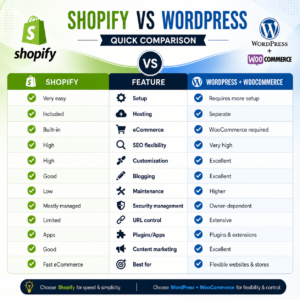
Shopify vs WordPress: Quick Comparison
What Is Shopify?
Shopify is a hosted commerce platform that provides the infrastructure required to build and operate an online store. It includes a storefront, checkout, product management, hosting and various commerce tools within one platform.
Because hosting and much of the technical infrastructure are managed by Shopify, beginners can launch a store without dealing with server configuration or WordPress-style plugin maintenance.
Shopify’s current India pricing starts at ₹1,499 per month when billed yearly for the Basic plan, according to its official pricing page.
Main advantages of Shopify
- Quick store setup
- Managed hosting
- Easy administration
- Built-in eCommerce functionality
- Professional themes
- App ecosystem
- Multichannel selling
- Less technical maintenance
For businesses that primarily want to sell products online without managing technical infrastructure, Shopify can be a practical choice.
What Is WordPress?
WordPress is a content management system rather than a dedicated eCommerce platform. To create a complete online store, businesses commonly use WooCommerce.
WooCommerce is an open-source eCommerce platform built on WordPress. It provides product management, checkout, payments, shipping, extensions and other eCommerce functionality while allowing businesses to control their website and underlying code.
WordPress is particularly useful for businesses that want their website to combine:
- eCommerce
- Blogging
- SEO
- Landing pages
- Content marketing
- Custom functionality
- Advanced integrations
WordPress also provides built-in SEO-related functionality around permalinks, sitemaps and search-engine accessibility, while plugins can extend its capabilities considerably.
Shopify vs WordPress for SEO
SEO is one of the biggest reasons businesses compare these platforms.
The important point is that Shopify is not bad for SEO. It provides many SEO fundamentals, including sitemap functionality and tools for managing search-related website settings.
However, WordPress offers a greater level of customization.
Shopify SEO
Shopify allows businesses to optimize:
- Page titles
- Meta descriptions
- Images
- Product pages
- Collections
- URLs within its platform structure
- Sitemap
- Canonical handling
- Structured data through themes and apps
The main advantage is simplicity. Many technical elements are handled by the platform.
WordPress SEO
WordPress provides greater control over:
- Permalink structures
- Meta information
- Canonical URLs
- Schema markup
- Robots directives
- XML sitemaps
- Internal linking
- Breadcrumbs
- Content architecture
- Noindex rules
SEO plugins can add even more functionality. For example, WooCommerce SEO solutions can provide product structured data, ecommerce XML sitemaps and canonical management.
SEO winner: WordPress + WooCommerce
If your strategy depends heavily on content marketing, technical SEO and complete control, WordPress has an advantage.
If you want solid SEO without managing many technical details, Shopify can be sufficient.
Shopify vs WordPress for eCommerce
Shopify has an important advantage because eCommerce is its primary purpose.
You can create products, manage inventory, configure payments, manage orders and operate your store from one platform.
WooCommerce can provide comparable functionality, but the setup is more modular. You may need additional extensions for particular payment, shipping, subscription, booking or business requirements.
The latest WooCommerce comparison documentation highlights this fundamental difference: Shopify provides a managed environment, while WooCommerce allows merchants to choose their hosting, functionality and integrations.
Shopify is better for:
- Beginners
- Standard online stores
- Fast launches
- D2C brands
- Businesses with limited technical resources
WooCommerce is better for:
- Custom stores
- Complex product requirements
- Advanced integrations
- Content-heavy businesses
- Businesses needing greater control
Shopify vs WordPress for Customization
Customization is one of WordPress and WooCommerce’s biggest strengths.
Because WooCommerce is open source, developers can modify the website’s code, functionality, templates and integrations.
You can customize:
- Product pages
- Checkout
- Pricing
- Customer accounts
- Shipping logic
- Payment workflows
- Website design
- Database
- APIs
- Integrations
Shopify also supports significant customization through themes, apps and APIs, but the platform operates within Shopify’s architecture.
Winner: WordPress + WooCommerce
For businesses requiring highly customized functionality, WordPress generally provides more freedom.
Shopify vs WordPress Pricing
Pricing needs to be evaluated beyond the initial platform fee.
Shopify currently lists its Basic plan in India at ₹1,499/month when billed annually, with higher plans available for businesses requiring additional capabilities.
With WordPress and WooCommerce, the core eCommerce software can be used without a Shopify-style monthly platform subscription, but you need to account for other expenses.
WordPress costs can include:
- Domain
- Hosting
- Premium theme
- Plugins
- WooCommerce extensions
- Security
- Backup
- Developer
- Maintenance
- Performance optimization
Therefore, it is misleading to say:
“WordPress is free and Shopify is expensive.”
The better comparison is total cost of ownership.
Shopify generally offers more predictable infrastructure costs, while WooCommerce allows you to choose exactly which hosting, extensions and services you pay for.
Shopify vs WordPress for Beginners
If you’re building your first online store, Shopify generally has the easier learning curve.
With Shopify, the process is relatively straightforward:
Create account → Choose theme → Add products → Configure payments → Configure shipping → Launch
With WordPress, you typically need to manage hosting, WordPress installation, WooCommerce, themes, plugins and website maintenance.
Winner: Shopify
If you don’t have technical knowledge or a developer, Shopify can save considerable time.
Shopify vs WordPress for Security
Shopify manages much of the underlying platform infrastructure, which reduces the technical security responsibilities of the store owner.
With WordPress, website owners need to pay more attention to:
- WordPress updates
- Plugin updates
- Theme updates
- Hosting security
- Backups
- Malware protection
- Access control
This doesn’t mean WordPress is inherently insecure. It means that greater control comes with greater responsibility.
Winner for simplicity: Shopify
Winner for control: WordPress
Shopify vs WordPress for Performance
Neither platform is automatically faster in every situation.
Shopify manages the infrastructure, making performance management simpler for merchants.
WordPress provides greater control over:
- Hosting
- Caching
- CDN
- Database
- Plugins
- Server configuration
This means an experienced developer can optimize a WordPress website extensively.
However, excessive plugins can introduce performance overhead. WooCommerce’s own engineering team has discussed how large WordPress applications can improve performance by loading only the plugins needed for particular requests.
Practical conclusion
Shopify: easier performance management.
WordPress: greater performance control.
Shopify vs WordPress for Scalability
Both platforms can support growing businesses.
Shopify’s advantage is managed infrastructure.
WordPress and WooCommerce can also scale, but the hosting architecture, caching, database and code need to be configured appropriately.
For a rapidly growing business, the decision should therefore consider:
- Traffic
- Product catalog size
- Order volume
- Integrations
- Hosting
- Development resources
- International expansion
Don’t assume that one platform is automatically better simply because the business becomes larger.
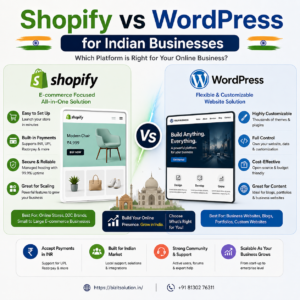
Shopify vs WordPress for Indian Businesses
For Indian businesses, platform selection can also depend on:
- UPI
- Razorpay
- Cash on Delivery
- GST
- Shipping integrations
- INR
- Indian marketplaces
- Regional SEO
Both ecosystems can support Indian payment and business requirements through integrations.
The better choice depends on how much customization your business needs.
For a straightforward Indian D2C store, Shopify can simplify operations.
For a business requiring custom GST logic, complex integrations or an existing WordPress website, WooCommerce can be more flexible.
Choose Shopify if you:
- Want to launch quickly
- Are new to eCommerce
- Don’t want to manage hosting
- Prefer simpler maintenance
- Have a standard product catalog
- Want an eCommerce-first platform
Choose WordPress + WooCommerce if you:
- Prioritize SEO and content marketing
- Need extensive customization
- Want greater control over your website
- Need custom integrations
- Already use WordPress
- Want greater control over hosting and code
Shopify vs WordPress: Pros and Cons
Shopify Pros
- Easy to use
- Fast setup
- Managed hosting
- Strong eCommerce features
- Lower technical maintenance
- Good scalability
- Large app ecosystem
Shopify Cons
- Recurring subscription
- App costs can increase expenses
- Less control over infrastructure
- Some customizations require platform-specific solutions
WordPress + WooCommerce Pros
- Highly customizable
- Strong SEO flexibility
- Excellent blogging capabilities
- Open-source
- Greater data and hosting control
- Large plugin ecosystem
- Excellent for content marketing
WordPress + WooCommerce Cons
- More technical setup
- Hosting required
- More maintenance
- Plugin conflicts can occur
- Security and performance require attention
Conclusion: Shopify vs WordPress — Which Should You Choose?
There is no universal winner in the Shopify vs WordPress comparison.
Shopify is an excellent choice for businesses that want simplicity, fast setup, managed infrastructure and an eCommerce-focused platform. It is particularly suitable for beginners, D2C brands and businesses that don’t want to spend significant time managing technology.
WordPress with WooCommerce is a stronger choice for businesses that need SEO flexibility, content marketing, customization and greater control over their website and eCommerce environment. WooCommerce’s open-source architecture allows businesses to customize code, hosting and integrations according to their requirements.
So, shopify vs wordpress which is better ultimately depends on your business.
Choose Shopify for simplicity. Choose WordPress + WooCommerce for flexibility and control.
If you want to build practical digital marketing skills, you can learn from Manjeet Madhukar, who provides professional digital marketing training along with real-world digital marketing services. His guidance can help you understand SEO, social media marketing, paid advertising and other essential skills while gaining practical industry knowledge.
FAQs
1. Shopify vs WordPress which is better for SEO?
WordPress with WooCommerce generally provides greater SEO control, especially for advanced content strategies, custom URLs, schema and technical SEO. Shopify offers strong built-in SEO features and is easier to manage.
2. Is Shopify better than WordPress for eCommerce?
Shopify can be better for businesses that want an easy, managed eCommerce platform. WooCommerce can be better when extensive customization and control are required.
3. Is WordPress cheaper than Shopify?
Not necessarily. WooCommerce itself can reduce platform costs, but WordPress websites still require hosting, themes, plugins, extensions, security and maintenance.
4. Which is easier to use, Shopify or WordPress?
Shopify is generally easier for beginners because hosting and much of the technical infrastructure are managed for you.
5. Is Shopify good for SEO?
Yes. Shopify provides important SEO capabilities such as sitemap functionality, metadata controls and other technical SEO features.
6. Is WordPress good for eCommerce?
Yes. With WooCommerce, WordPress can become a powerful eCommerce platform with extensive customization and integration options.
7. Which is better for blogging, Shopify or WordPress?
WordPress is generally better for blogging and content marketing because content publishing is one of its core strengths.
8. Can I migrate from Shopify to WordPress?
Yes. Shopify stores can be migrated to WooCommerce, but product data, customers, orders, URLs, metadata and redirects need to be handled carefully. WooCommerce provides specific migration guidance for Shopify stores.
9. Which platform is better for small businesses?
Shopify is often easier for small businesses that want a quick online store. WordPress can be more suitable when SEO, content and customization are major priorities.
10. Which platform should I choose in 2026?
Choose Shopify if your priority is simplicity and managed eCommerce. Choose WordPress + WooCommerce if your priority is SEO, content, customization and control.