

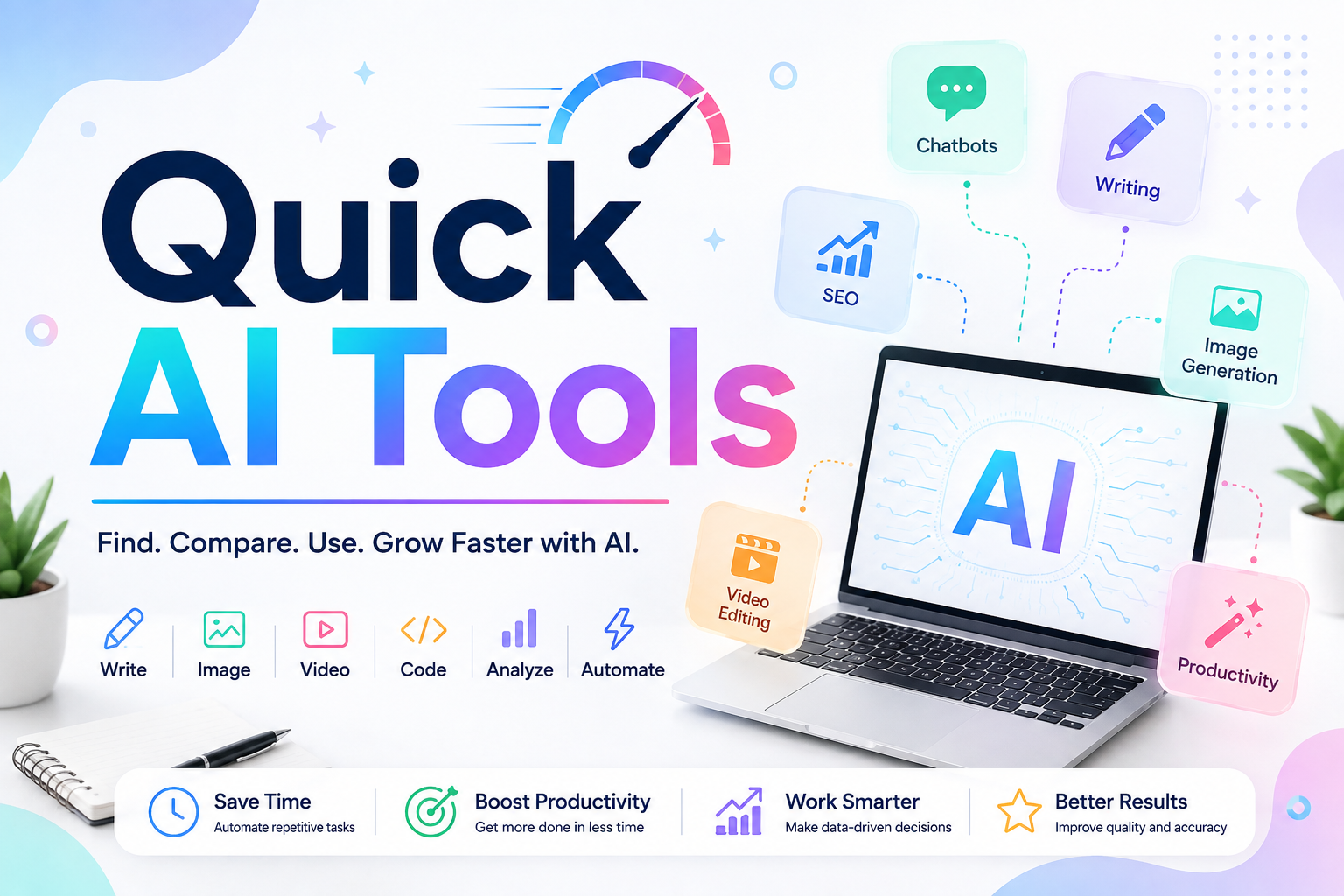
Artificial intelligence has changed the way people work, create content, market businesses, conduct research and manage everyday tasks. Instead of spending hours completing repetitive activities, users can now use quick ai tools to generate content, analyze information, create visuals, optimize websites and automate workflows.
The challenge, however, is no longer finding an AI tool. There are thousands of AI-powered platforms available, and many of them offer overlapping features. The real challenge is finding the right tool for the right task without wasting time testing dozens of platforms.
Modern AI directories are responding to this problem by organizing tools according to categories, pricing, features and use cases. For example, current AI directories classify tools into writing, image generation, coding, productivity, video, marketing and research categories.
This is where quick ai tools can make AI discovery easier. Instead of searching through countless websites, users can explore tools based on what they actually need to accomplish.
What Are Quick AI Tools?
Quick ai tools are online AI-powered applications designed to help users complete specific tasks efficiently. These tools can range from AI writing assistants and image generators to SEO platforms, coding assistants, research tools and productivity applications.
Some tools are designed for a single purpose, such as removing an image background or summarizing text. Others provide multiple capabilities through one platform.
The biggest advantage is convenience. Users can identify their task, select an appropriate AI solution and start working without spending excessive time researching software.
AI tool directories increasingly provide information such as pricing, categories, features and reviews so users can make better decisions before trying a platform.
Why Are Quick AI Tools Becoming Popular?
The popularity of AI tools is closely connected to the growing demand for faster digital workflows.
Businesses and individuals use AI to:
- Create content faster
- Generate marketing ideas
- Improve SEO
- Create social media posts
- Analyze data
- Generate images and videos
- Write and explain code
- Summarize documents
- Automate repetitive activities
- Research topics
- Improve productivity
However, using AI effectively does not necessarily mean using the largest number of tools. Recent digital marketing research emphasizes choosing tools according to specific workflows and business requirements rather than collecting unnecessary software subscriptions.
The purpose of quick ai tools should therefore be simple: help users identify and use the most suitable solution faster.
Types of Quick AI Tools
There are several major categories that users can explore depending on their requirements.
1. AI Writing Tools
AI writing tools help users create, rewrite, summarize and improve written content.
Common applications include:
- Blog writing
- Product descriptions
- Email writing
- Social media captions
- Ad copy
- Summaries
- Paraphrasing
- Grammar improvement
- Content ideas
These tools are particularly useful for marketers, bloggers, students, agencies and business owners who regularly work with written content.
2. AI Image Tools
AI image platforms can help users generate or edit visual content using text prompts or existing images.
Popular applications include:
- AI image generation
- Background removal
- Image enhancement
- Photo editing
- Product photography
- Social media graphics
- Marketing creatives
AI directories currently include dedicated categories for image generation and design tools, making it easier to discover solutions according to visual requirements.
3. AI Video Tools
Video has become an essential part of digital marketing and content creation. AI video tools can assist with:
- Text-to-video creation
- Video editing
- AI avatars
- Voiceovers
- Subtitles
- Short-form video creation
- Content repurposing
These platforms can reduce the amount of manual editing required to produce digital video content.
4. AI Coding Tools
Developers can use AI tools to generate, explain and improve code.
Typical applications include:
- Code generation
- Debugging
- Code explanation
- Documentation
- Code completion
- Programming assistance
AI directories currently list dedicated code assistants and developer tools alongside writing, design and productivity solutions.
5. AI Productivity Tools
Productivity-focused AI tools can help with:
- Meeting notes
- Transcription
- Presentations
- Document creation
- Task management
- Research
- Workflow automation
- Knowledge management
The goal is not simply to automate everything, but to reduce repetitive work so users can focus on higher-value activities.
Quick AI Tools for Marketing
One of the most valuable applications of AI is digital marketing. quick AI tools for marketing can support almost every stage of a marketing workflow, from research and content creation to advertising, social media and analytics.
Current 2026 marketing research organizes AI solutions around functions such as SEO, content, paid advertising, email, social media, automation and analytics.
AI Tools for Content Marketing
Marketers can use AI to generate:
- Blog ideas
- Content briefs
- Headlines
- Social media captions
- Email campaigns
- Product descriptions
- Ad variations
- Content summaries
AI can significantly speed up the first stage of content production, but human review remains important for accuracy, originality, brand voice and expertise.
AI Tools for SEO
SEO professionals can use AI for:
- Keyword research
- Search intent analysis
- Content briefs
- Competitor research
- Content optimization
- Meta titles
- Meta descriptions
- Internal linking ideas
- Content gap analysis
Current marketing guides commonly include platforms such as Semrush, Ahrefs and Surfer among AI-assisted SEO workflows.
The best approach is to use AI for research and efficiency while keeping strategic decisions and quality control with experienced marketers.
AI Tools for Social Media
Social media teams can use AI to create:
- Captions
- Content ideas
- Post variations
- Visual concepts
- Video scripts
- Content calendars
- Repurposed content
AI can make it easier to transform one piece of content into multiple formats for different social platforms.
AI Tools for Advertising
AI can assist with:
- Ad copy variations
- Creative concepts
- Audience analysis
- Campaign optimization
- Performance insights
- Landing page messaging
Current 2026 marketing research highlights AI-powered advertising systems and creative-generation platforms as important parts of modern paid media workflows.
Learn AI and Digital Marketing with Manjeet Madhukar’s through practical courses covering AI tools, SEO, social media marketing, and digital marketing strategies.
AI Tools for Email Marketing
Email marketers can use AI for:
- Subject lines
- Email copy
- Personalization
- Customer segmentation
- Campaign ideas
- Automated workflows
AI becomes particularly useful when marketers have large audiences and need to personalize communication efficiently.
How to Choose the Right AI Tool
Having hundreds of options does not mean you need hundreds of subscriptions. Before selecting a tool, consider the following factors.
1. Identify Your Task
Start with the problem you want to solve.
For example:
“I need to create an SEO content brief.”
This is more useful than searching for:
“Best AI tool.”
2. Check Pricing
AI platforms can be:
- Completely free
- Freemium
- Subscription-based
- Usage-based
Many directories distinguish between these pricing models because a “free” tool may still place limits on usage or advanced features.
3. Check Ease of Use
A powerful platform is not necessarily the best choice if it takes too long to learn.
For quick tasks, look for:
- Simple interface
- Fast output
- Clear instructions
- Minimal setup
- Easy export options
4. Check Features
Compare the features that actually matter for your workflow rather than choosing a tool because it has the largest feature list.
5. Check Limitations
Before relying on a platform, check:
- Usage limits
- Output quality
- Commercial-use rules
- Data handling
- Signup requirements
- Integration availability
6. Compare Alternatives
The best AI tool depends on your requirements. A platform that works well for a marketing agency may not be the best choice for a student or small business.
Benefits of Using Quick AI Tools
Using the right AI platform can provide several benefits.
Saves Time
Automating repetitive tasks can reduce the amount of manual work required.
Improves Productivity
Users can complete more tasks within the same working period.
Supports Creativity
AI can provide ideas, variations and starting points when users face creative blocks.
Reduces Repetitive Work
Tasks such as summarization, formatting, transcription and content variations can often be accelerated.
Helps Small Businesses
Small teams can access capabilities that previously required multiple specialized resources.
Makes Technology More Accessible
Many AI tools work directly through web browsers, allowing users to start without complex installations.
How to Use AI Tools Responsibly
AI should be treated as an assistant rather than an automatic replacement for human judgment.
Always review AI-generated information before publishing or using it for important decisions. Check facts, statistics, claims, copyright considerations and sensitive information.
For marketing content, AI can help with speed and structure, but human expertise is still essential for originality, brand positioning and credibility. Current marketing research similarly emphasizes the importance of combining AI capabilities with human judgment rather than relying on automation alone.
The Future of AI Tools
The AI tool landscape is moving beyond simple content generation.
Modern platforms increasingly combine:
- AI agents
- Automation
- Research
- Data analysis
- Multimodal generation
- Workflow integrations
- Personalization
Recent 2026 marketing research shows AI becoming integrated into broader workflows involving research, content, advertising, analytics and automation rather than remaining a standalone writing assistant.
This means the future of AI discovery will likely focus less on how many tools exist and more on which tool is appropriate for a specific task.
That is why well-organized quick ai tools directories can provide real value by helping users discover, compare and select suitable solutions.
Conclusion
AI is becoming an important part of everyday digital work, but the growing number of platforms can make choosing the right solution difficult. From writing and SEO to images, video, coding, research and productivity, there are now specialized tools for almost every digital task.
The real value of quick ai tools is not simply providing a large list of AI platforms. It is helping users quickly understand what each tool does, who it is designed for, how much it costs and whether it is suitable for their particular requirement.
For marketers, quick AI tools for marketing can support content creation, SEO, social media, advertising, email campaigns and analytics. However, successful AI adoption depends on choosing tools according to actual business goals and combining automation with human expertise.
As AI continues to develop, users will increasingly need reliable ways to discover and compare tools. A well-organized AI tools platform can make that process faster, simpler and more useful.
FAQs About Quick AI Tools
1. What are quick AI tools?
Quick AI tools are online AI-powered applications designed to help users complete specific tasks efficiently, including writing, research, SEO, image creation, video production, coding and productivity.
2. Are quick AI tools free?
Some AI tools are completely free, while others offer free plans with usage limitations or operate on a freemium or paid model. Always check the current pricing and limitations before choosing a tool.
3. What are the best quick AI tools for marketing?
The best option depends on the marketing task. Marketers can use AI tools for content creation, SEO, social media, advertising, email marketing, research and analytics. Current 2026 marketing guides recommend choosing tools based on specific workflow requirements rather than using one platform for everything.
4. Can AI tools help with SEO?
Yes. AI-assisted SEO tools can support keyword research, content planning, competitor analysis, content optimization and other SEO workflows.
5. Can AI tools create marketing content?
Yes. AI can assist with blog ideas, social media captions, email copy, advertisements, product descriptions and other marketing content. Human review should be used to ensure accuracy and brand consistency.
6. How do I choose the right AI tool?
Start by identifying the task you need to complete. Then compare the tool’s features, pricing, ease of use, limitations, integrations and output quality.
7. Are AI tools useful for small businesses?
Yes. Small businesses can use AI to accelerate content creation, customer communication, marketing, research, design, productivity and repetitive workflows without needing a large team.
8. Will AI tools replace human marketers?
AI can automate and accelerate many marketing tasks, but strategy, creativity, brand understanding, critical thinking and human judgment remain important. The strongest approach is generally AI-assisted marketing rather than completely AI-dependent marketing.

