
Digital marketing has become a combination of creativity, technology, data analysis, content, search, advertising, and customer engagement. For beginners, the biggest challenge is often not finding information but knowing what to learn first, what to practice next, and how different marketing channels work together.
A well-structured digital marketing roadmap provides that direction. Current 2026 learning resources from Coursera, TISA-TECH, Digital Trainee and Kraftshala emphasize structured learning, practical projects, analytics, specialization, AI tools and portfolio development rather than learning disconnected marketing skills.
Whether you are a student, job seeker, business owner, freelancer or someone changing careers, the following guide explains how to build your skills step by step.
What Is a Digital Marketing Roadmap?
A digital marketing roadmap is a structured learning and implementation plan that shows which digital marketing skills to learn, in what order, and how to practice them.
Instead of trying to learn SEO, social media, Google Ads, email marketing and analytics simultaneously, you can develop your knowledge progressively.
A useful learning sequence is:
Marketing Fundamentals → Website → SEO → Content → Social Media → Paid Advertising → Email → Analytics → CRO → AI → Specialization → Portfolio
Coursera’s current learning framework similarly emphasizes step-by-step skill development combined with hands-on projects and emerging tools.
Why Do You Need a Digital Marketing Roadmap?
Digital marketing contains many disciplines. Beginners can easily become overwhelmed by the number of platforms, tools and strategies available.
A structured approach helps you:
- Understand marketing fundamentals before advanced techniques
- Learn one skill at a time
- Practice skills on real projects
- Understand how different channels connect
- Measure marketing performance
- Build a professional portfolio
- Select a specialization
- Prepare for jobs or freelance work
Digital Trainee’s 2026 beginner framework similarly recommends building a foundation, learning individual skills sequentially, prioritizing practical work, and then adding automation and AI.
Step 1: Learn Digital Marketing Fundamentals
The first stage of your digital marketing roadmap should focus on understanding how marketing works.
Learn concepts such as:
- Target audience
- Buyer persona
- Customer journey
- Marketing funnel
- Brand positioning
- Value proposition
- Lead generation
- Conversion
- Customer retention
- Key performance indicators (KPIs)
You should also understand the difference between organic marketing and paid marketing.
For example, SEO can attract organic search traffic, while Google Ads can generate paid traffic. Social media can support awareness and engagement, while email marketing can help nurture existing leads and customers.
Practical exercise
Choose a business and create:
- Target audience
- Buyer persona
- Marketing funnel
- Three marketing goals
- Five relevant KPIs
This gives you a foundation before moving into individual channels.
Step 2: Learn Website and Landing Page Basics
A website is often the central asset connecting different digital marketing channels.
Your learning path should include:
- Domain and hosting
- WordPress basics
- Website navigation
- Landing pages
- Contact forms
- Calls to action
- Mobile optimization
- Basic user experience
- Website speed
- Conversion-focused page structure
TISA-TECH’s current beginner roadmap uses a WordPress website as a practical environment where learners can apply SEO and other digital marketing skills.
Practical project
Create a simple website with:
- Home page
- About page
- Services/products
- Blog
- Contact page
Then connect analytics and search tools so you can practice measurement later.
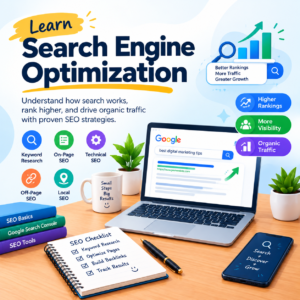
Step 3: Learn Search Engine Optimization
SEO should be an important part of your digital marketing roadmap because it teaches you how people search for information and how websites can become discoverable through search engines.
Keyword Research
Learn:
- Seed keywords
- Long-tail keywords
- Search volume
- Search intent
- Keyword competition
- Keyword clustering
- Keyword mapping
On-Page SEO
Understand:
- Title tags
- Meta descriptions
- Headings
- URLs
- Internal links
- Image optimization
- Content structure
- Search intent
Technical SEO
Learn about:
- Crawling
- Indexing
- XML sitemaps
- Robots.txt
- Canonical URLs
- Mobile usability
- Page performance
- Structured data
Off-Page and Local SEO
You should also understand:
- Backlinks
- Digital PR
- Brand mentions
- Local citations
- Google Business Profile
- Online reviews
- Local landing pages
TISA-TECH’s 2026 roadmap gives particularly extensive attention to on-page, technical and off-page SEO, keyword research, AEO and GEO.
Practical project
Select a website and perform:
Keyword research → SEO audit → content plan → on-page optimization → internal linking → performance measurement.
Step 4: Learn Content Marketing
Content marketing turns audience research and SEO knowledge into useful information.
Learn how to create:
- Blog posts
- Guides
- Case studies
- Videos
- Infographics
- Social posts
- Email content
- Lead magnets
Understand the three major funnel stages:
TOFU – Awareness
Educational content that introduces a problem or topic.
MOFU – Consideration
Comparisons, guides, case studies and solutions.
BOFU – Conversion
Product pages, service pages, demos and offers.
Practical project
Create a 30-day content calendar containing:
- Blog topics
- Primary keywords
- Search intent
- Content format
- Target audience
- Funnel stage
Step 5: Learn Social Media Marketing
Social media is another important stage of a complete digital marketing roadmap.
Learn:
- Instagram marketing
- Facebook marketing
- LinkedIn marketing
- YouTube
- Short-form video
- Content calendars
- Community management
- Social analytics
- Influencer marketing
- Social advertising
Don’t focus only on publishing posts. Learn how to connect content with business objectives.
For example:
Content → Engagement → Website visit → Lead → Conversion
Practical project
Create a 30-day campaign for a business with:
- 15–20 posts
- Short-form video ideas
- Captions
- Hashtag/keyword strategy
- Posting schedule
- Performance KPIs
Step 6: Learn Google Ads and PPC
After understanding organic marketing, move into paid advertising.
Learn:
- PPC fundamentals
- Campaign structure
- Keywords
- Match types
- Negative keywords
- Ad copy
- Landing pages
- Conversion tracking
- CPC
- CTR
- CPA
- ROAS
Also understand how advertising decisions should connect to business goals.
For example:
Business goal → Audience → Campaign → Ad → Landing page → Conversion → Measurement
Practical project
Create a mock Google Ads campaign containing:
- Campaign objective
- Keyword list
- Ad groups
- Negative keywords
- Ad copy
- Landing page
- Budget
- KPIs
Step 7: Learn Meta Ads
Once you understand paid marketing fundamentals, explore Meta advertising.
Learn:
- Campaign objectives
- Audience targeting
- Custom audiences
- Lookalike audiences
- Retargeting
- Creative testing
- Budget management
- Conversion tracking
- Campaign reporting
The objective is not simply to create advertisements but to understand testing, measurement and optimization.
Step 8: Learn Email Marketing
Email marketing helps businesses communicate with people after the initial interaction.
Learn:
- Lead generation
- Lead magnets
- Email lists
- Segmentation
- Newsletters
- Welcome sequences
- Promotional campaigns
- Lead nurturing
- Automation
- Email analytics
A simple workflow can look like:
Website visitor → Lead form → Email sequence → Product/service information → Offer → Follow-up
This connects email with the wider customer journey.
Step 9: Learn Analytics and Tracking
Analytics should be integrated into your digital marketing roadmap rather than treated as an optional final skill.
Learn:
Google Analytics
Understand:
- Users
- Traffic sources
- Engagement
- Events
- Conversions
Google Search Console
Understand:
- Search queries
- Impressions
- Clicks
- CTR
- Search position
- Indexing
Tracking
Also learn:
- UTM parameters
- Conversion tracking
- Google Tag Manager
- Dashboard creation
Your objective should be to answer:
What happened, why did it happen, and what should we change next?
Current 2026 digital marketing content increasingly emphasizes data, performance measurement and business impact alongside channel skills.
Step 10: Learn Conversion Rate Optimization
Traffic is only one part of digital marketing. You also need to understand what happens after visitors arrive.
Learn:
- Landing-page optimization
- CTA optimization
- Forms
- Headlines
- Trust signals
- User behavior
- A/B testing
- Conversion funnels
For example:
1000 visitors → 50 leads → 10 customers
CRO focuses on understanding how that funnel can be improved.
Step 11: Learn AI for Digital Marketing
AI is an important component of a modern digital marketing roadmap, but it should be treated as an assistant rather than a replacement for strategy.
AI can help with:
- Content ideas
- Research
- Keyword clustering
- Content briefs
- Ad copy variations
- Social media ideas
- Email drafts
- Data analysis
- Reporting
- Automation
Digital Trainee’s 2026 roadmap specifically recommends using AI to improve research, content, analysis and efficiency while retaining human strategy and review.
You should also become familiar with AEO (Answer Engine Optimization) and GEO (Generative Engine Optimization) as emerging areas associated with AI-powered search and discovery. Current 2026 roadmaps increasingly include these topics alongside traditional SEO.
Step 12: Build Practical Projects
A digital marketing roadmap becomes much more valuable when every learning stage produces something tangible.
Consider building:
- Website project
- Keyword research project
- SEO audit
- Content strategy
- Social media campaign
- Google Ads campaign
- Meta Ads campaign
- Email campaign
- Analytics dashboard
- Complete marketing campaign
For every project, document:
Objective → Research → Strategy → Execution → Metrics → Results → Lessons
This creates material that can later become your portfolio.
Step 13: Choose a Digital Marketing Specialization
You don’t have to become an expert in every discipline.
Your digital marketing roadmap can eventually branch into a specialization.
SEO Specialist
SEO + content + technical SEO + analytics
PPC Specialist
Google Ads + Meta Ads + tracking + CRO
Social Media Specialist
Content + social platforms + community + paid social
Content Marketer
Research + SEO + writing + content strategy
Email/CRM Specialist
Email + segmentation + automation + CRM
Performance Marketer
Paid advertising + analytics + CRO + attribution
Kraftshala’s career-focused roadmap similarly highlights different specialist roles and pathways within digital marketing.
A Simple 6-Month Learning Plan
Month |
Main Focus |
Practical Output |
1 |
Fundamentals + Website |
Practice website |
2 |
SEO + Keyword Research |
SEO audit |
3 |
Content + Social Media |
Content campaign |
4 |
Google Ads + Meta Ads |
Advertising project |
5 |
Analytics + Email + CRO |
Dashboard + funnel |
6 |
AI + Portfolio |
Complete case study |
The exact learning speed depends on your existing knowledge, available time and amount of practical work.
Common Mistakes Beginners Should Avoid
When following a digital marketing roadmap, avoid:
- Trying to learn every channel simultaneously
- Focusing on tools before understanding concepts
- Watching tutorials without practicing
- Running ads without conversion tracking
- Ignoring analytics
- Publishing content without understanding search intent
- Depending completely on AI-generated content
- Building skills without creating portfolio projects
- Expecting immediate results
Current beginner-focused research similarly emphasizes learning sequentially and prioritizing practical application over passive consumption.
If you want to build practical digital marketing skills, you can learn from Manjeet Madhukar, who provides professional digital marketing training along with real-world digital marketing services. His guidance can help you understand SEO, social media marketing, paid advertising and other essential skills while gaining practical industry knowledge.
Conclusion
A successful digital marketing roadmap should provide more than a list of marketing channels. It should show you what to learn, when to learn it, how to practice it and how to measure your progress.
Start with marketing fundamentals and website basics, then develop skills in SEO, content, social media, paid advertising, email and analytics. After building the core skills, explore CRO, AI, AEO, GEO and automation. Finally, choose a specialization and build practical projects that demonstrate your abilities.
For anyone following a digital marketing roadmap for beginners, the most useful approach is to progress gradually: learn → practice → measure → document → specialize. Current 2026 resources from Coursera and other learning platforms similarly emphasize practical projects, skill development and career preparation rather than theory alone.
FAQs
1. What is a digital marketing roadmap?
It is a structured plan that explains which digital marketing skills to learn, the order in which to learn them, and how to practice and measure those skills.
2. What should I learn first in digital marketing?
Start with marketing fundamentals, target audiences, customer journeys, funnels, websites and basic analytics before moving into specialized channels.
3. Is this digital marketing roadmap suitable for beginners?
Yes. A digital marketing roadmap for beginners should start with fundamentals and gradually introduce SEO, content, social media, paid advertising, analytics and AI.
4. How long does it take to learn digital marketing?
The timeline depends on your previous experience and study schedule. A structured beginner program can establish core skills over several months, while developing professional-level expertise requires continued practical experience.
5. Should I learn SEO or Google Ads first?
Both are useful, but beginners can first understand organic marketing and audience research before progressing into paid advertising. The important point is to understand the purpose and measurement of each channel.
6. Is AI important for digital marketing in 2026?
AI is increasingly used for research, content assistance, analysis, advertising workflows and automation. It should complement marketing knowledge rather than replace strategy and human review.
7. How can I build a digital marketing portfolio?
Create practical projects such as SEO audits, content campaigns, social media plans, advertising campaigns, email sequences and analytics dashboards. Document your objective, process, results and lessons.
8. What are the main digital marketing career paths?
Common paths include SEO, PPC/performance marketing, social media, content marketing, email/CRM, analytics and broader digital marketing roles.